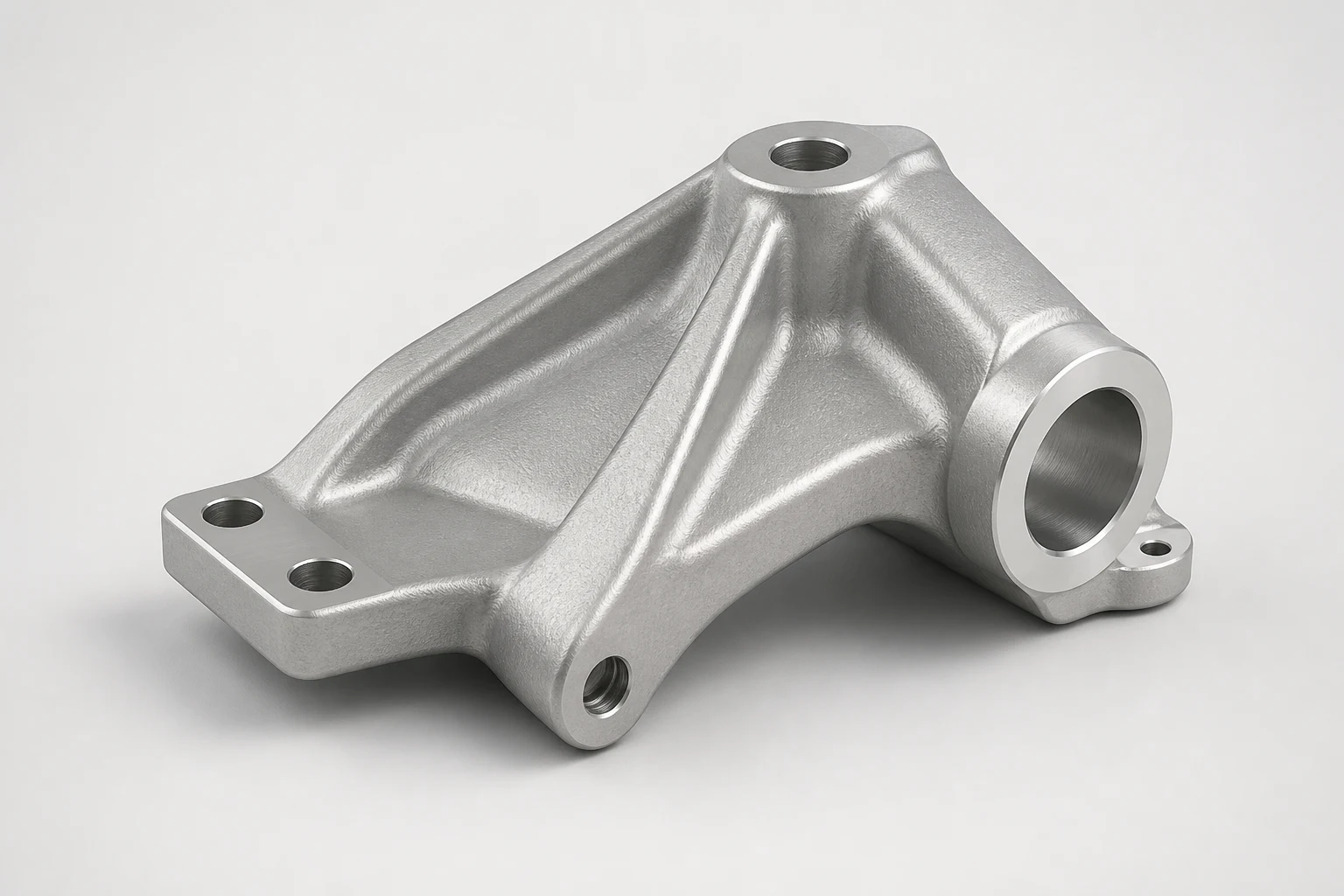
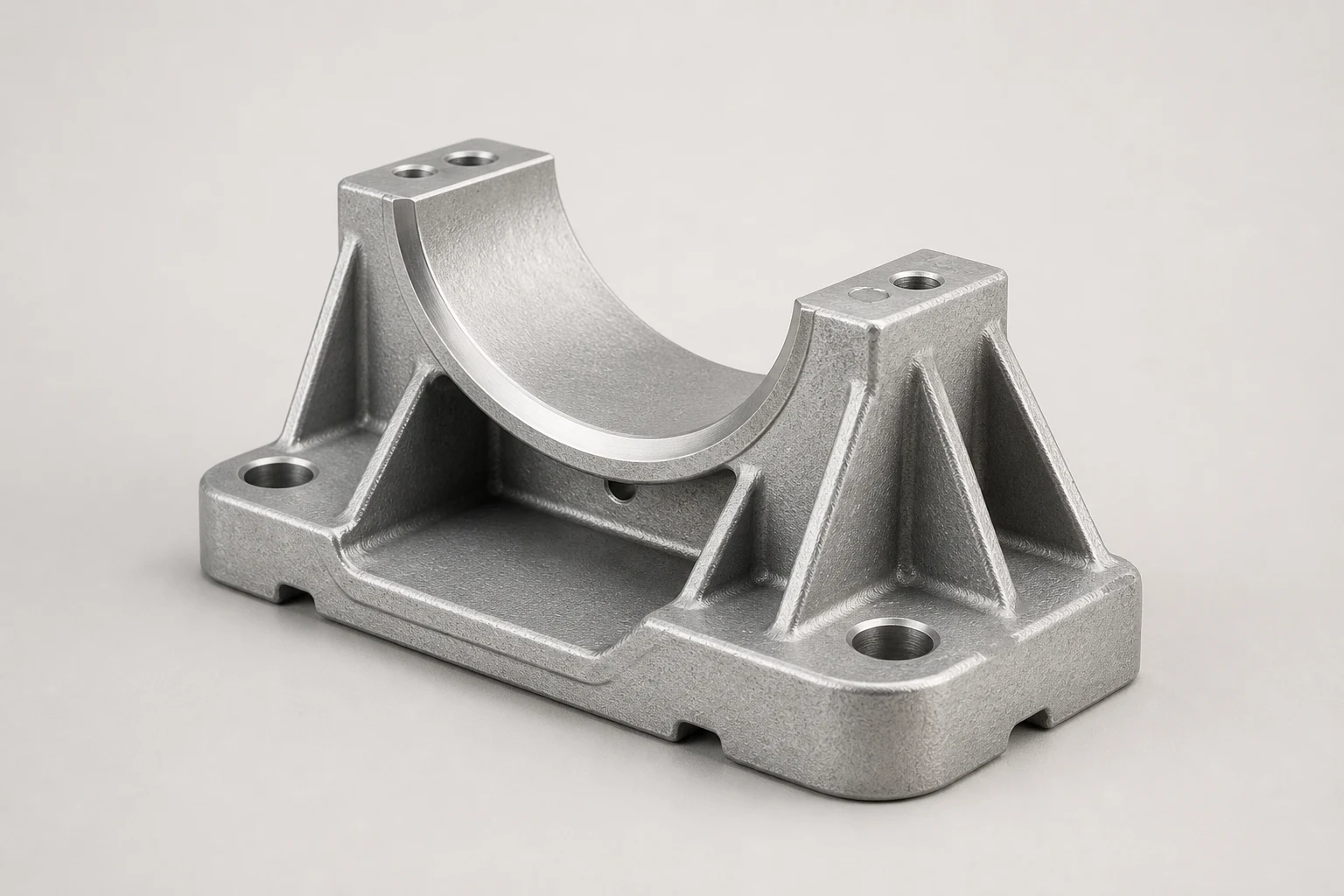
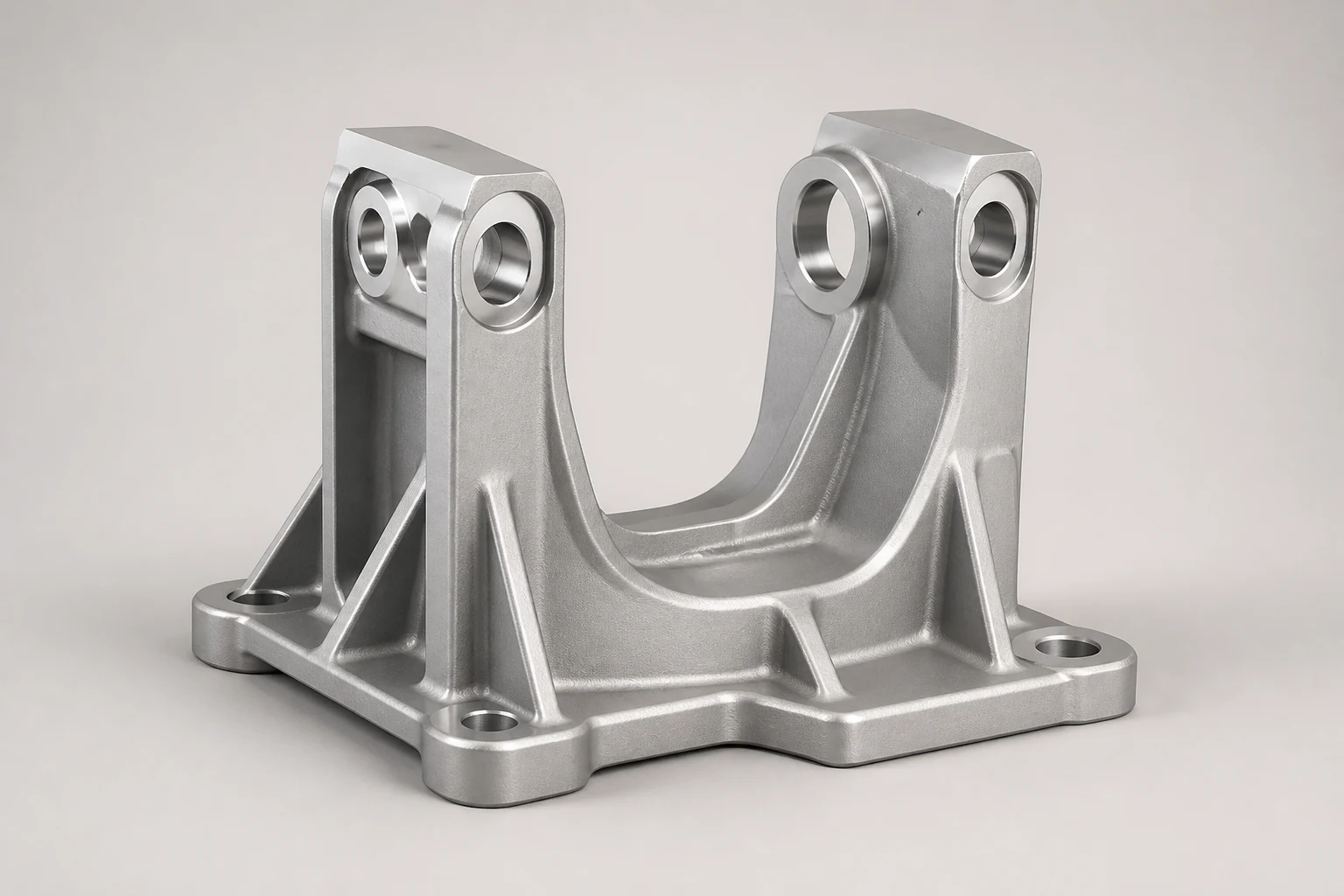
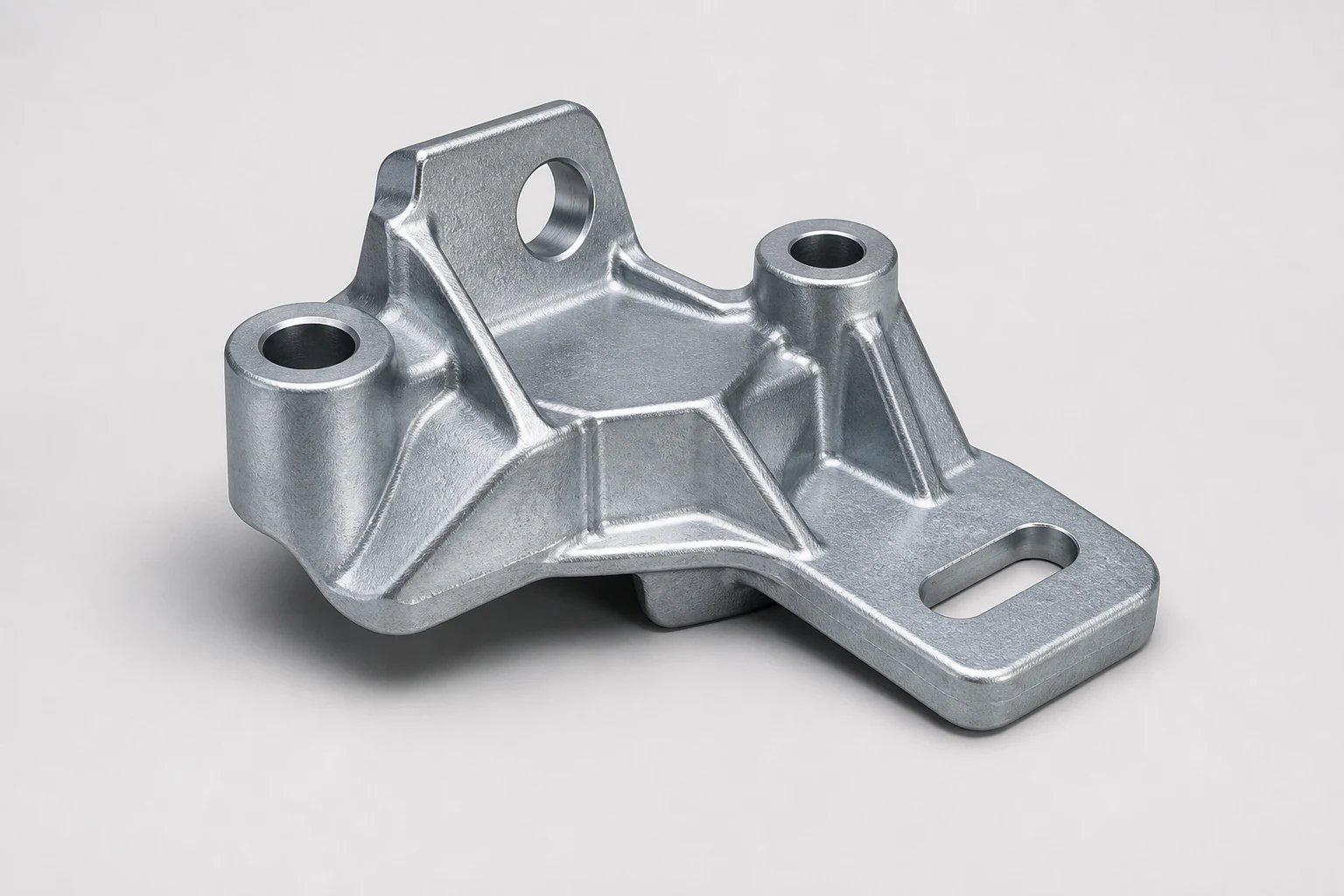
We make brackets to the customer’s drawing: mounting brackets, frame mounts and other parts that carry a load. Brackets make up most of our product examples, including parts for mobility aids, garden equipment and vehicles.
Made to drawing, not from a catalogue
We hold no standard brackets in stock. If you need a catalogue angle bracket, a hardware or industrial wholesaler will get it to you faster. Here the bracket is made to your drawing, in a casting tool you own, and in series. For die casting that typically means a few thousand parts per year or per order. Gravity die casting typically works at a fifth to a tenth of that.
What characterises a bracket
A bracket has a load path. Force enters at one point, travels through the section and out into the fixing points. Everything else about the part is secondary. The most common design error we see is a bracket drawn as a folded plate and then “converted to a casting” by adding draft angles. The result is heavier than it needs to be, with a load path that runs through a sharp internal transition.
A cast bracket should be drawn as a casting from the start: a thin, even wall in the shell, ribs where the bending moment is, generous radii in every internal corner, and material concentrated where the stress actually is.
When casting fits
- The load path can run in three dimensions. A bent plate has two. A cast bracket can carry force around a corner, down into a foot and out into four bolt holes without a single weld.
- No heat-affected zone. A welded bracket has a zone beside the weld where the material is weakened. A cast bracket does not.
- Hole positions come from the tool. The holes sit in the same place in every part of the series. That repeatability is what keeps your assembly line running.
- Ribs are almost free. In sheet metal every stiffener costs an operation. In casting it costs a little metal and a little cycle time.
When casting does not fit
- The bracket is in practice a folded plate and the quantity is small. Laser cutting and press braking are cheaper, both in tooling and per part.
- You need only a handful and the part will not be made again. Machining from billet is the better route. The worked example shows how to find the line.
- The requirement is documented fatigue strength in a safety-critical structure with certified material data. Forged, or machined from extruded profile, is often more appropriate than a casting.
- The part must be stainless steel. We cast aluminium and zinc.
Die casting or gravity die casting
For a load-bearing part this is the most important choice, and it usually comes down to whether the part is to be heat treated.
Die cast parts normally cannot be heat treated. The metal is injected at high pressure and some air travels with it. During a solution treatment near 500 degrees the trapped gas expands and raises blisters under the surface. If tensile strength has to come up through heat treatment, the part therefore has to be gravity die cast.
Gravity die casting gives a longer cycle, thicker walls and a rougher surface, but it opens the door to heat treatment. If the part is small and detailed, zinc die casting may be an option. We run both casting methods and choose according to what the part has to withstand. How that choice is made is explained under aluminium casting.
From drawing to finished bracket
We review the drawing before the tool is ordered. We call it positive product criticism: wall thickness, draft angles, radii, parting line and the tolerances on holes and seating faces. We then procure the casting tool, which you own, and cast and machine the bracket here in Råde. Blasting is done in house. If the bracket is to be anodised or powder coated, a sub-supplier does it, and we order and follow up that step.
What customers usually ask
What do you need to quote? The drawing, preferably as STEP, and quantities per order and per year. Mark the holes and faces that are critical, and tell us what the bracket has to withstand. Request a quote.
What does the tool cost? It depends on the geometry. How tooling cost is built up.
Have you made anything similar? See the load-bearing bracket for mobility aids, the bracket for garden equipment and the heat treated gravity die cast bracket.