Garden equipment
Bracket for garden equipment
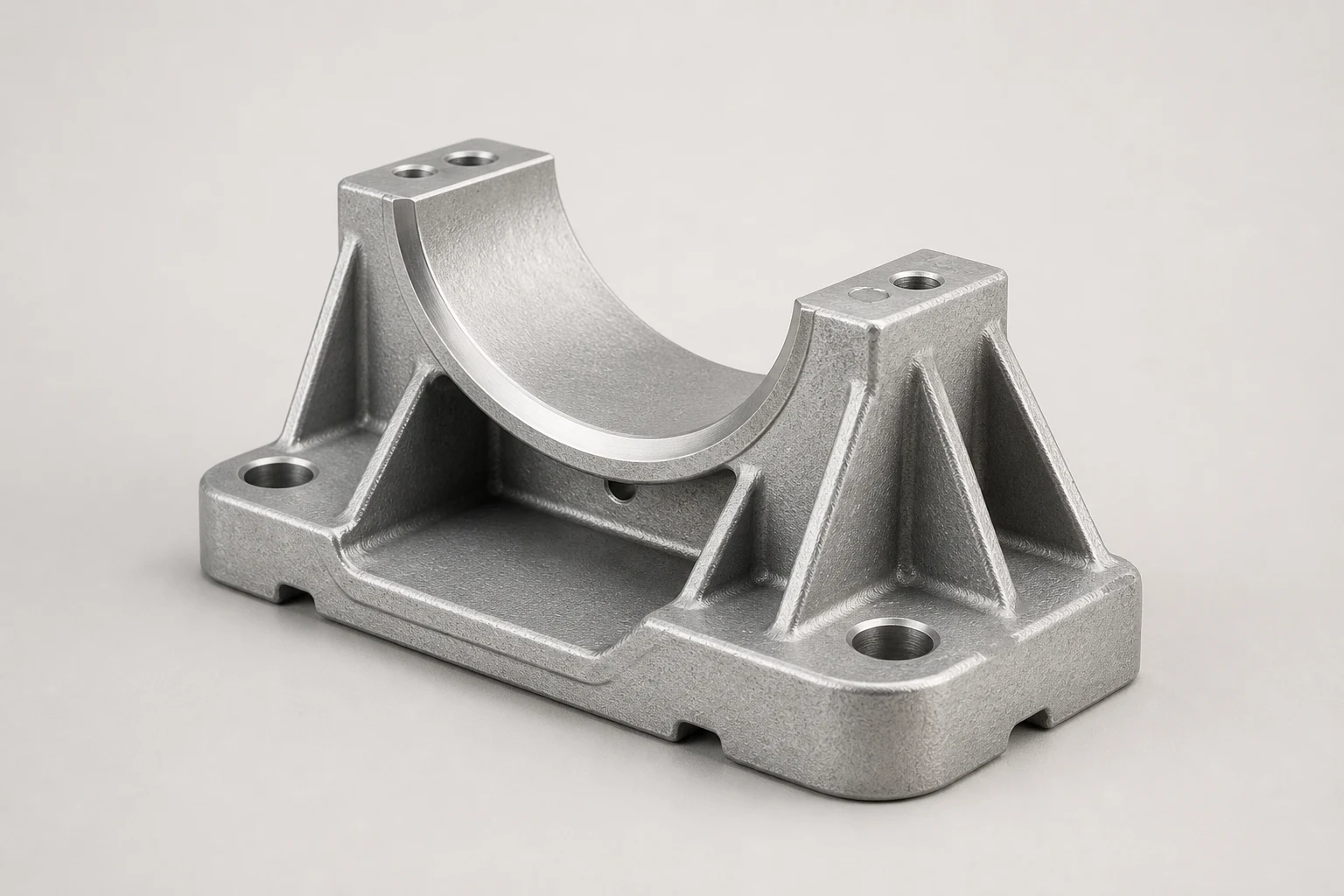
An aluminium die casting for consumer volumes, cast with the bearing fit and pressure tightness straight from the tool — with no subsequent machining.
The challenge
A part made in large quantities. Here the margin sits in the part, not in the brand, and the cost per piece decides whether the customer can make the product at all.
Two requirements made this part difficult:
The bearing fit. The bracket carries a fit that has to receive a bearing. Fits are normally the first thing you machine after casting, because casting tolerance is coarser than fit tolerance. But in a volume segment every post-operation is a cost multiplied by the annual volume.
Pressure tightness. The part has to be tight. Porosity in the section — gas bubbles from the casting process, or shrinkage voids where the metal contracted during solidification — can create leak paths through the wall. That is not something you machine away. It has to be designed and cast away.
Every step we could remove from the process chain was money straight to the customer. Every operation we failed to remove was too — in the other direction.
The solution
Aluminium die casting, with the tool designed to hit the critical dimensions directly. The principles below show how a part like this is solved.
The tolerance is taken in the tool, not in the mill. If a fit is to be cast to size, it has to sit in one die half — never across the parting line, where two halves meet and every micron of die wear feeds straight into the dimension. The core that forms the fit must also be cooled under control, so shrinkage is predictable from shot to shot.
Tightness is taken in the fill. Pressure tightness in a die casting is about how the melt enters and where the air leaves. The gate is placed so the front fills in a controlled way instead of atomising; overflows and vents are placed where air would otherwise be trapped. Wall thickness is kept even, because local accumulations solidify last and produce shrinkage voids in exactly the place the section should have been soundest.
Positive product criticism as a pricing tool. When quantities are large, design changes turn straight into money: less metal means lower material cost, and a thinner section solidifies faster and shortens the cycle. A worked example: ten grams less on a part you make 40,000 of a year is 400 kilos less metal a year, on top of the machine time saved.
The result
The part leaves the tool with the bearing fit and the tightness already in place. No subsequent machining of the critical dimensions.
For the customer that means an entire operation is out of the calculation — not only the machine time, but the handling, the fixturing, the intermediate storage and the inspection that come with it.
It is worth noting what this presupposes: that the tolerance requirement was realistically set for the process. If the drawing calls for a tighter tolerance than casting can hold, the face has to be machined, and then material has to be added for it. That judgement is made before the tool is designed, not after the first trial run.
High pressure die casting because the volume is large and cycle time is the dominant cost driver. Aluminium because the part sits in equipment that is lifted and carried. No machining, because the tolerance requirement could be hit in the tool — and because every operation removed is multiplied by the annual volume.