Hopp til hovedinnhold

Component manufacturer · Råde, Norway · in operation since 1945

You draw the part. We cast it, machine it and hand it back finished.

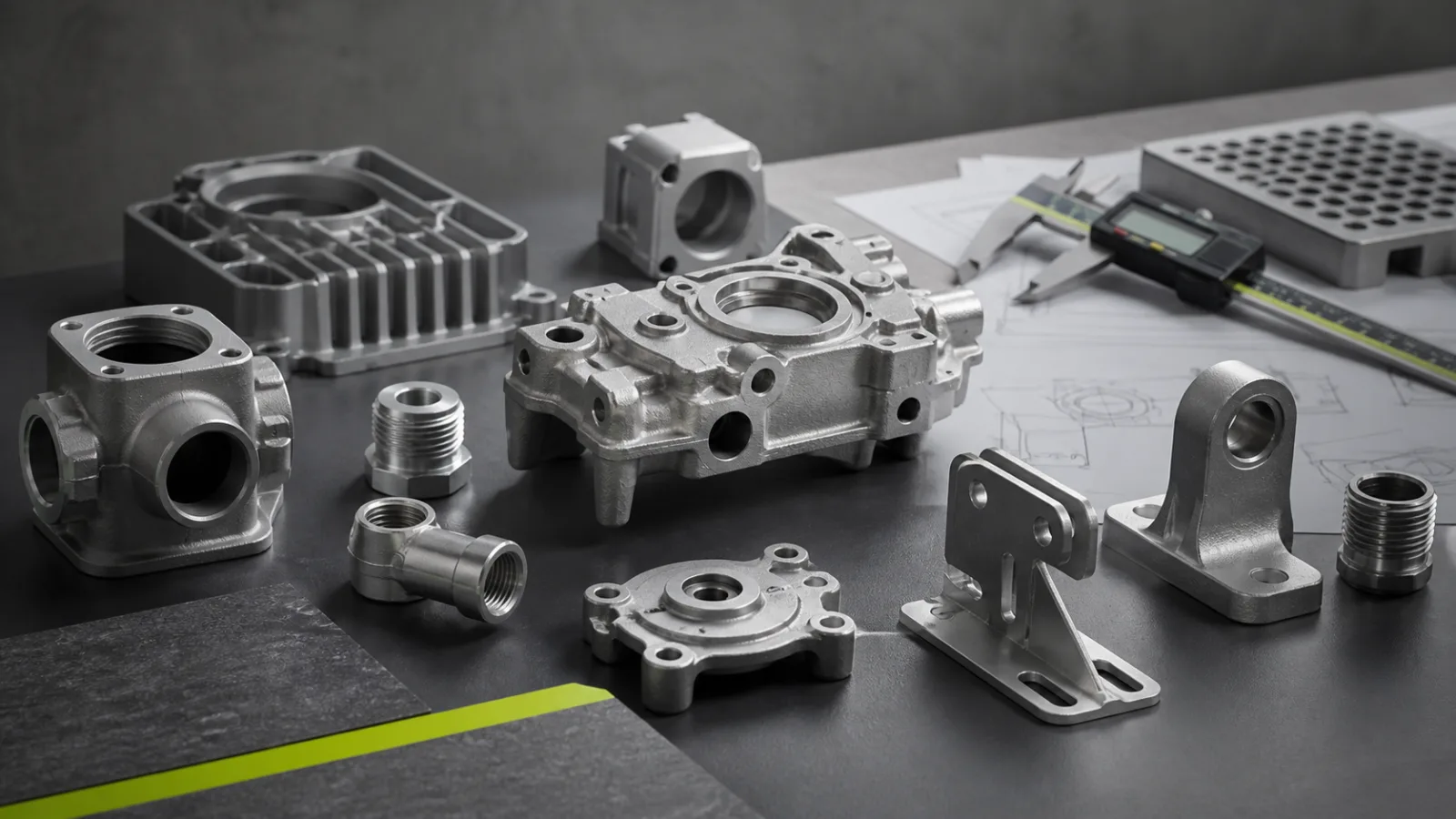
Brackets, housings and fittings in aluminium and zinc. High pressure or gravity die cast, heat treated, machined and shot blasted in the same building. The part does not leave Råde until it is ready to assemble.

You get an answer within 24 hours — an estimate if all we have is a sketch, a formal quotation if you have final files. Including when the answer is that the part should be made some other way.

In short

Figures we cannot document are not shown here. They sit in the capability tables, marked “Available on request”.

1945

Casting in Østfold since

30+ years

of CNC machining in our own shop

Al + Zn

Aluminium and zinc under one roof

24 hours

to an answer on an enquiry

What we make

Components, not castings

The difference is what you get in your hand. A foundry hands you a raw casting that you then have to send on to someone else for degating, heat treatment, machining and finishing. We hand you the finished part.

Our parts weigh from a few grams to several kilos. They sit in wheelchairs and walking aids, in garden tools, in loudspeakers, in furniture, and in fittings on board ferries. One bracket in the portfolio is cast to critical tolerances for a bearing fit and for pressure tightness — with no subsequent machining at all. Another is gravity die cast and heat treated to raise tensile and ultimate strength. The process is chosen from what the part has to withstand, not from which machine happens to be free.

We have no products and no brand of our own. Every single part that leaves this building was drawn by a customer, and is treated as that customer's property. That is why our product examples are anonymised.

Four functions

What your part has to do decides how it gets made

We do not sort components by material or process, but by function. The function decides which requirements are critical — and therefore which process and which metal is right.

Brackets and load-bearing parts

Brackets and load-bearing parts

Parts that transfer force. The centre of gravity in our portfolio: brackets for mobility aids, garden equipment, marine and vehicles. Here strength, freedom from porosity and hole position decide — not the surface.

Se komponenttypen
Housings and covers

Housings and covers

Parts that surround and protect something. Electronics housings, loudspeaker enclosures, covers and casings. Here thin even wall, dimensional accuracy and flat sealing faces decide.

Se komponenttypen
Fittings and threaded parts

Fittings and threaded parts

Parts whose entire purpose is to connect two other parts. The value sits in the interfaces — the threads, the holes, the seating faces. That is why they are cast and machined under one roof.

Se komponenttypen
Visible parts

Visible parts

Parts the end user actually sees. Appearance then becomes a specification on a par with the dimensions: no parting line or ejector marks on exposed faces, an even surface, the correct colour.

Se komponenttypen

The whole chain

Six links. Five of them happen here.

We cast the bracket, heat treat it, machine the mounting points and blast it. It does not leave the building until it is finished. The sixth link — anodising and powder coating — goes out to established subcontractors. That is one extra transport and a few extra days, and we would rather say so than pretend it happens here.

Design review

We go through wall thickness, draft angles, radii, undercuts, parting line and tolerance requirements before you get a price. We call it positive product criticism.

Pressure die casting

Aluminium and zinc under high pressure. Thin walls, complex geometry, seconds per shot. This is the process behind most of our parts.

Gravity die casting

Gravity fill into a permanent steel mould. Heavier sections, lower tooling cost — and parts that can be heat treated afterwards.

Heat treatment

Gravity die cast aluminium parts that need more strength are heat treated here. Pressure die cast parts normally are not — entrapped gas causes blistering.

CNC machining

Turning, milling and boring on our own machines, programmed in Fusion 360. Faces and holes needing tighter tolerances than casting gives are done here.

Surface finishing

Blasting we do ourselves. Anodising and powder coating go to established subcontractors — we manage that link, but we do not own it.

The sharp end

Zinc die casting — almost nobody in Norway does this

Four of the eight parts we show are cast in zinc. Yet zinc is barely mentioned by any Norwegian supplier, ourselves included, until now.

Zinc melts at around 385 °C. Aluminium melts at 660 °C and is cast at 680–700 °C. That difference is the whole point. Lower metal temperature means less thermal shock in the steel die, so a zinc die takes far more shots than a comparable aluminium die.

European zinc die casters publish 750,000 to 2,000,000 shots, eight to ten times an aluminium tool. We have not put a figure on the life of our own dies — but since you own the tool, this is your economics, not ours.

The low melting point also allows thinner walls, sharper detail reproduction and better dimensional accuracy than aluminium. And zinc is heavier: 6.6 against 2.7 g/cm³. In a loudspeaker housing that weight is an advantage — the mass damps unwanted vibration. We choose zinc where mass is a function, not a compromise.

Decision helper

Should your part be cast?

Six questions decide it — the same six we work through when a drawing comes in.

6 spørsmål · under ett minutt

0/6

01 How many parts do you need per year?

Volume decides whether the tool can pay for itself. Pressure die casting wants a few thousand parts per year or per order; gravity casting works at a fifth to a tenth of that, because the tool costs less. A clear ambition towards volume counts too — we look at a customer’s total potential, not just the one part in the enquiry.

02 How complex is the geometry?

If the part can be folded from flat sheet, laser cutting and bending is nearly always cheaper, with no tooling cost at all. Casting wins when the form is genuinely three-dimensional, wall thickness varies, or several functions — ribs, mounting lugs, bosses, cable routes — have to be integrated into one part instead of welded up from several pieces.

03 Is the wall thickness even through the part?

Metal shrinks as it solidifies. If one section is twice as thick as the next, it freezes last and draws metal from its surroundings — that gives shrinkage porosity inside and distortion outside. The fix is usually to core out thick sections, or replace solid section with ribs. Ribs give stiffness without mass.

04 Does the part have draft angles?

The part has to come out of the die. Without draft it sticks, tears on ejection and wears the tool faster. Draft belongs on every face across the direction the die opens — including internal faces, holes and cut-outs. This is rarely what stops a part, but it is nearly always something that has to change, and we add it during the review.

05 Are there faces where a parting line and a few ejector marks can sit?

Where the die splits there is a thin line of flash. Where the ejector pins push there are marks. Both are physically unavoidable — the only question is where they land. Mark on the drawing which faces are visible or functionally critical and we will put the parting line elsewhere. If the whole part is visible and every face is a sealing or seating face, the parting line has to be bought back with machining.

06 How many dimensions carry tight tolerances?

Casting gives you a tolerance. If the requirement is tighter, the face has to be machined — which means machining allowance, which is metal you pay for and machine time you pay for. Put tight tolerances only where the function actually needs them. Five critical dimensions on a bracket is normal; fifty is usually inherited from a drawing made for machining from solid. We have not published our tolerance grade yet — state your requirement and we will tell you whether it holds as cast or has to be machined.

1/6

Sannsynlig vei videre

Your part should probably be cast

The volume carries, the geometry is too complex for sheet, and the tolerances are realistic. This is exactly the kind of part we make.

Send a drawing or a STEP file with an estimate of annual volume. You get an answer within 24 hours.

Sannsynlig vei videre

Probably — but the part needs adapting first

Most drawings that reach us are not adapted for casting when they arrive. That is exactly where the review pays for itself: every change points at less metal or a shorter cycle, and those are two of the five things you pay for on every single part.

Send it anyway — preferably before the design is frozen. Then we can influence the part while it can still be changed.

Sannsynlig vei videre

The part should probably be made some other way

If the volume is low or the geometry simple, the tool does not pay for itself — for you or for us. Then folded sheet, machining from solid or additive manufacturing is the better answer, and we would rather say so than sell you a tool that never pays off.

Call anyway if you are unsure. Five minutes on the phone is cheaper than a wrong investment, and we are happy to answer even when the answer is no.

Dette er en pekepinn, ikke et tilbud. Den endelige vurderingen gjør vi på tegningen din — det er der geometrien avgjør.

The alternatives

Our competitor is rarely another foundry

When you need a bracket, the question is not which foundry should cast it. The question is how the bracket should be made at all.

Our competitor is rarely another foundry
Kriterium Wins when Oss Loses to casting when
CNC from solid The series is small, the geometry simple, or you want to avoid tooling cost entirely. The series grows. Every part costs machine time; a casting shot costs seconds. And you buy away most of the material as chips.
Sheet metal (laser, bending, welding) The bracket can be folded from flat sheet. Very low tooling cost, short lead time. The part has a complex 3D form, varying wall thickness, or several functions that would otherwise be welded up from multiple pieces.
Glass-filled injection moulded plastic Volume is high, weight has to come down, and strength and temperature requirements are moderate. The part has to take high load, heat, UV or fire — or has to be recyclable as metal at end of life.
Metal injection moulding (MIM) The part is small, intricate and made in high volume. The part weighs more than a few tens of grams.
Stamping and pressing The part is flat or simply formed and made in very high volume. The geometry is genuinely three-dimensional.
Metal additive manufacturing Prototypes, one-offs and very small series. No tooling cost at all. The series passes a few dozen parts. Cost per part then climbs fast.
Imported castings Volume is large, the part is standardised, and lead time is not critical. You need short lead time, flexibility, one point of contact and a traceable supply chain — or you have to document origin and embedded emissions against the EU carbon border mechanism, CBAM.

We win where the part is too complex for sheet, too big for MIM, too high in volume for machining from solid, and too urgent or too low in volume for import. It is a narrow window — but it is exactly where brackets and housings in small and medium series land.

“As a manufacturer of ferry and passenger seating sold worldwide, it is essential that our subcontractors deliver the best quality on competitive terms. For more than 10 years Rolvsøy Metallindustri AS has supplied cast aluminium parts to West Mekan Produksjon AS.”

Konrad Skibenes CEO, West Mekan Produksjon AS

Got a drawing?

Send a STEP file or a PDF. You get an answer within 24 hours — an estimate if all we have is a sketch, a formal quotation if the files are final. If you have no drawing yet, better still: then we can influence the part while it can still be changed.

Vi bruker anonym besøksstatistikk for å forbedre nettstedet. Google Analytics lastes kun hvis du samtykker. Les mer