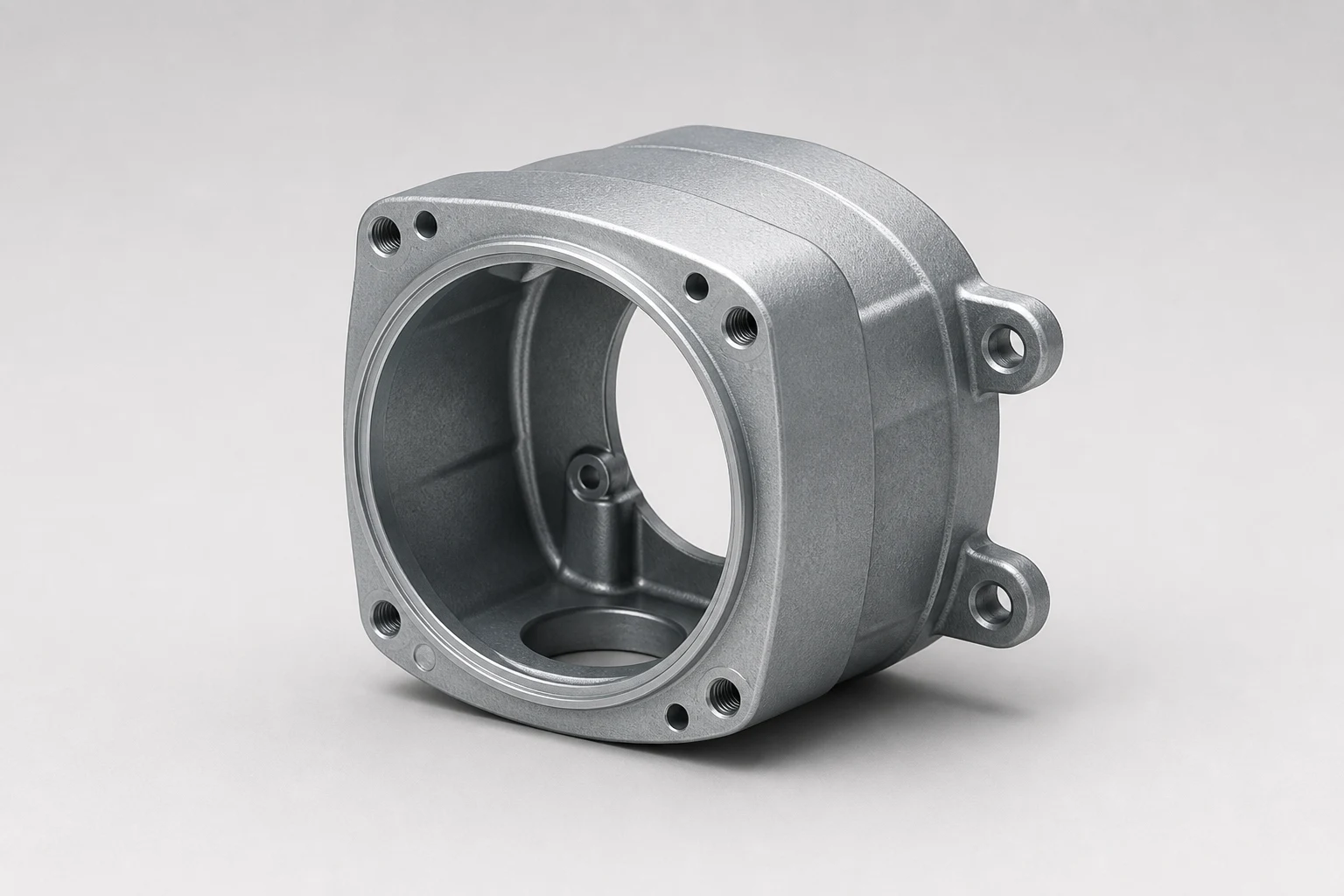
Zinc
Electronics and audio
Zinc loudspeaker housing
An enclosing part for audio equipment, die cast in zinc. Here weight is not a compromise — it is the function. A heavy housing damps unwanted vibration, and zinc is the heavier metal.
Casting and machining in Råde. Surface finishing coordinated by us.
Housings, covers and enclosures made to drawing, for electronics, audio equipment and anything else that needs protecting. Here thin, even walls, dimensional accuracy and flat sealing faces decide.
We cast housings, covers and enclosures to the customer’s drawing, in zinc or aluminium, and machine the sealing faces, contact faces and threaded holes here in Råde. A zinc loudspeaker housing is one of our product examples.
A housing is a shell with functions hung on the inside. The shell must be thin and even. The functions, such as screw bosses, ribs, cable entries, locating pins and gasket grooves, must be anchored in the shell without creating local accumulations of metal.
That conflict decides whether the housing turns out well. Where a screw boss meets a wall, the section suddenly doubles in thickness. That is where the metal solidifies last, and that is where you get shrinkage porosity. The fix is to core out the boss from the back and tie it into the wall with a rib instead of blending it into a lump.
Zinc gives finer detail, thinner walls, better dimensional accuracy and a surface that is often finished straight from the tool. The tool also lasts longer, because zinc melts at around 380–390 °C, while aluminium is cast at 680–700 °C. When you own the tool, that is a direct commercial argument.
Aluminium gives lower weight and better thermal conductivity. If the housing is load-bearing, or sits in something that has to be lifted, aluminium is usually right. Specific thermal conductivity and tensile figures are provided on request for the alloy in question. There is more on the choice in zinc or aluminium.
A cast housing can be made tight, shielding and heat-conducting, but none of it happens by itself. If the enclosure needs an IP rating, has to be pressure tight or must pass an EMC test, the requirement belongs in the enquiry, together with how it is to be verified. We then assess what can be achieved and documented for that particular part, before the tool is designed. We do not promise tightness or approvals in general terms.
We review the drawing before the tool is ordered: wall thickness, parting line, sealing faces and screw bosses. We procure the tool, and you own it. Casting, machining and blasting happen here. Powder coating, and anodising of aluminium housings, are done by sub-suppliers we order and follow up. Remember that coating insulates: if the housing has to shield, the contact faces must be masked or machined clean, and that has to be on the drawing. More on this under surface finishing.
What do I need to send for a price? The drawing, quantities per order and per year, and the housing’s requirements for sealing, shielding, heat and surface. Request a quote.
When is zinc the right material? Read zinc die casting: when zinc is right.
Electronics and audio
An enclosing part for audio equipment, die cast in zinc. Here weight is not a compromise — it is the function. A heavy housing damps unwanted vibration, and zinc is the heavier metal.
Housings and covers
Where the boss meets the wall the section doubles. That is where the metal solidifies last, and that is where the shrinkage void appears. Core the boss from behind and tie it in with a rib.
Uneven wall thickness causes distortion during cooling. If two halves must seal against each other, the face is either cast against a solid core or milled afterwards.
Powder coating insulates. If the housing is to shield electromagnetically, the contact faces must be masked or machined clean after coating. This has to be on the drawing.
Electronics and audio
An enclosing part for audio equipment, die cast in zinc. Here weight is not a compromise — it is the function. A heavy housing damps unwanted vibration, and zinc is the heavier metal.
Tell us whether the housing has to seal, shield or carry heat away. We then look at wall thickness, parting line, sealing faces and screw bosses before you get a price.
Send the drawing and a rough quantity. We look at the part before we work out a price.
We count visits anonymously to make the website better. Google Analytics only loads if you say yes. Read more