Material selection
Zinc die casting in Norway — when zinc is right
When does zinc make a better part than aluminium? Five technical reasons to choose zinc, what tool life means when you own the tool, and four cases where aluminium is the better choice.
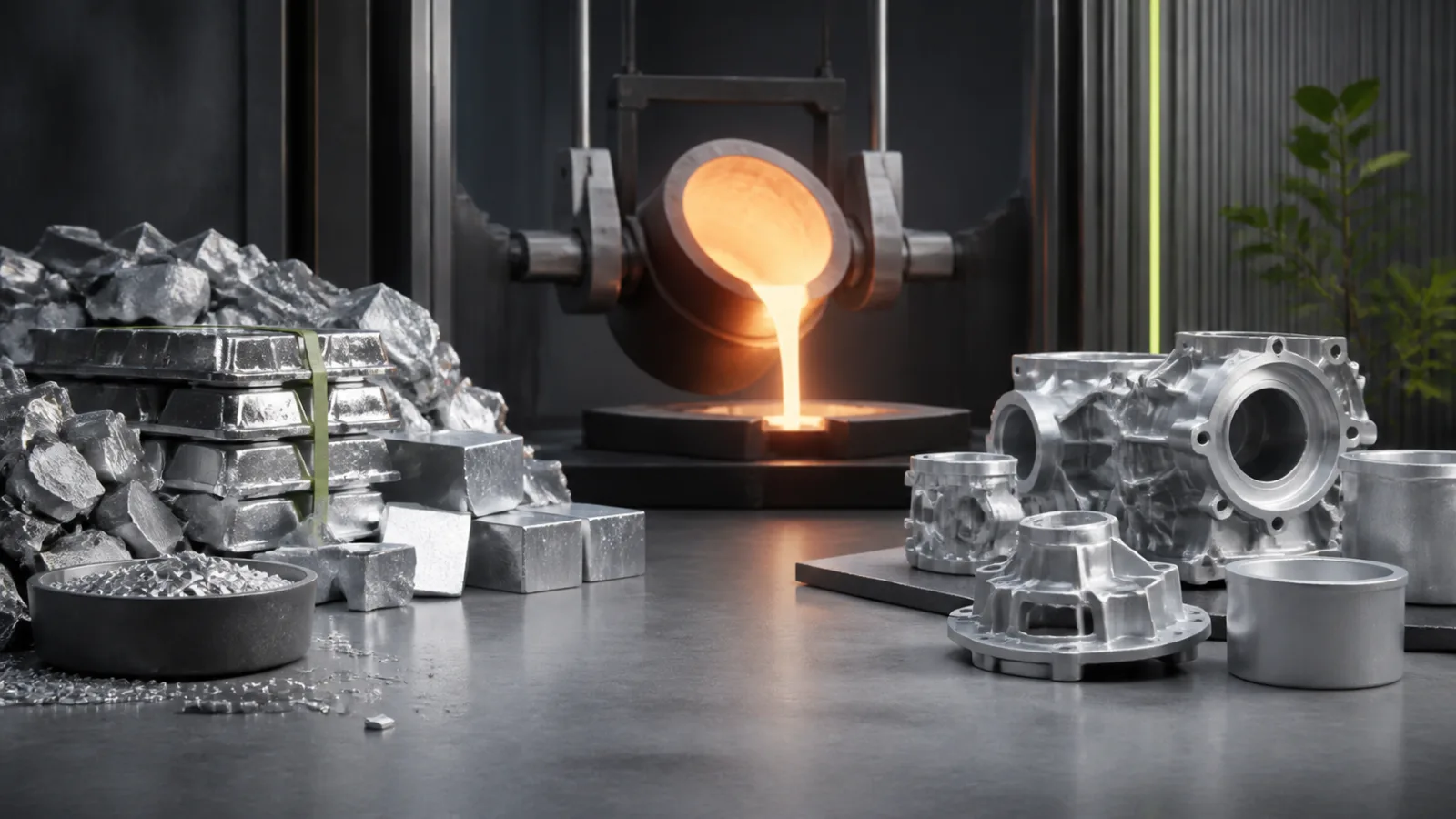
Zinc is an underrated casting metal. Very few Norwegian suppliers offer zinc die casting, so many parts end up in aluminium because it was available, not because it was right.
This article is a guide to when zinc makes the best part, and when it does not. If you want to go straight to what we offer, see zinc die casting.
What zinc die casting actually is
In principle the process is the same as aluminium die casting: molten metal is injected into a steel die under high pressure, and the part solidifies in seconds.
The difference lies in the temperature and in the machine. Zinc melts at around 380–390 °C, while aluminium is cast at 680–700 °C. That large temperature gap explains most of what separates the two materials in production.
Because zinc melts so low, it can run in hot chamber machines, where the injection system sits submerged in the melt itself. Aluminium would dissolve such a system and therefore has to be dosed into a separate shot sleeve for every shot. The hot chamber process is faster, which gives shorter cycle times on zinc parts than on comparable aluminium parts.
The alloys are called Zamak, after the four elements zinc, aluminium, magnesium and copper. They differ mainly in copper content, which affects strength, hardness and long-term dimensional stability.
Five technical reasons to choose zinc
1. Detail. Zinc reproduces finer detail than aluminium. Sharp edges, fine texture, small lettering and thin ribs come out of the die more crisply. On a part with a lot of geometry in a small format, this is the difference between a good part and a nearly good part.
2. Thin walls. Zinc flows well in the die at low temperature and fills thin sections precisely. The German zinc die caster Adolf Föhl states wall thicknesses down to 0.3 mm in its production. That is thinner than most people believe possible in cast metal, and it opens up designs that would otherwise have required plastic.
3. Dimensional accuracy. Zinc holds dimensions better than aluminium. Where two halves meet along a sealing face, or where a hole has to match a hole in another part across a series of hundreds of thousands, that is a real advantage.
4. As-cast surface. The lower casting temperature loads the tool less. The result is a finer surface straight from the die — often good enough to use without finishing. On a visible fitting that is an entire operation saved.
5. Threads. Zinc takes threads particularly well. The material is soft enough for the thread to form cleanly without tearing, and hard enough for it to hold under tightening. On a part that will be unscrewed again — furniture, enclosures, serviceable parts — that means the thread can go straight into the part rather than requiring an insert.
Tool life, the argument that gets forgotten
This is one of the strongest economic arguments for zinc, and it is often forgotten.
A casting tool is gradually destroyed by thermal shock. Every single shot heats the die surface and cools it again. Over time that produces micro-cracks, erosion at the gate and increasing flash along the parting line.
At 380 degrees that degradation happens far more slowly than at 700.
Adolf Föhl states a tool life of 750,000 to 2,000,000 shots for zinc tooling, and puts that at eight to ten times the life of an equivalent aluminium tool.
Why this matters to you: in our business model the customer owns the tool. It is your investment. If you plan to make 300,000 parts over ten years, whether you need one tool or three is a significant sum — and it is a sum that does not appear in the unit price quotation.
When mass is the function, not the problem
Zinc weighs more than aluminium. In most contexts that counts as a drawback, and it is one reason the material gets ruled out reflexively.
But there are parts where the weight does work.
A loudspeaker cabinet has an acoustic problem: the driver moves, and the reaction force sets the housing vibrating. A housing that vibrates radiates its own sound, and that sound does not belong in the signal. The remedy is mass and stiffness — the same force produces less acceleration in a greater mass.
There, zinc is the right choice rather than a compromise. The same applies to furniture fittings, where weight in the hand is read as solidity by the end user, and to parts that have to damp vibration from an engine.
The right metal for the job is not automatically the lightest metal.
Four cases where you should choose something else
We do not sell zinc for everything. Here is when it is wrong:
Weight is critical. If the part is lifted, carried or flown, the lower density of aluminium decides. A mobility aid the user has to lift into a car is an aluminium product.
The part gets hot in service. Zinc has a lower service temperature than aluminium. If the part sits near a motor, power electronics or a heat source, the temperature has to be checked against the alloy before anything else.
The part is to be anodised. Anodising is an aluminium process. Zinc can be coated in other ways, but if you want an anodised finish, the material choice is already made.
The part needs heat treatment to high tensile strength. The precipitation hardening mechanism belongs to aluminium. If you need T6 strength, what you want is a gravity cast aluminium part.
Two words that decide the zinc part
The difference between hot chamber and cold chamber is the technical basis for everything above. In a hot chamber machine the injection system sits down in the melt itself, and zinc can be run that way because the melt temperature is low enough for the steel to survive standing in it. Aluminium would dissolve such a system and has to be dosed into a cold chamber for every shot. It is the hot chamber process that gives zinc the shorter cycle and the die the longer life.
The second word is shot weight: the total weight of metal injected per cycle, gate and overflow included. It is the shot weight, not the part weight, that decides whether a part runs on a given machine — and because zinc is 2.4 times denser than aluminium, a shot weight limit in grams is reached on a physically smaller part in zinc.
What to tell us when you ask
For a precise answer on whether zinc suits your part, four things help:
- What the part has to do — what it carries, what it encloses, what it joins.
- Where it sits — indoors, outdoors, in salt atmosphere, near a heat source.
- Whether weight is an advantage or a drawback — it is not obvious until you say so.
- Annual volume and order size — that decides whether the tool pays off.
Send the drawing or the sketch. You get an answer after a technical review, with a justification, including when the answer is that your part should be aluminium or should not be cast at all. One example of a part where zinc was right is the zinc loudspeaker housing. Request a quote.
- zinc
- zamak
- die casting
- material selection
- tool life