Design
Threads in castings — cast, cut or insert
Two figures decide the choice: how many times the screw comes out again, and at what torque. Here are the three methods, when each is right, and what has to be correct in the hole before the thread can be made.
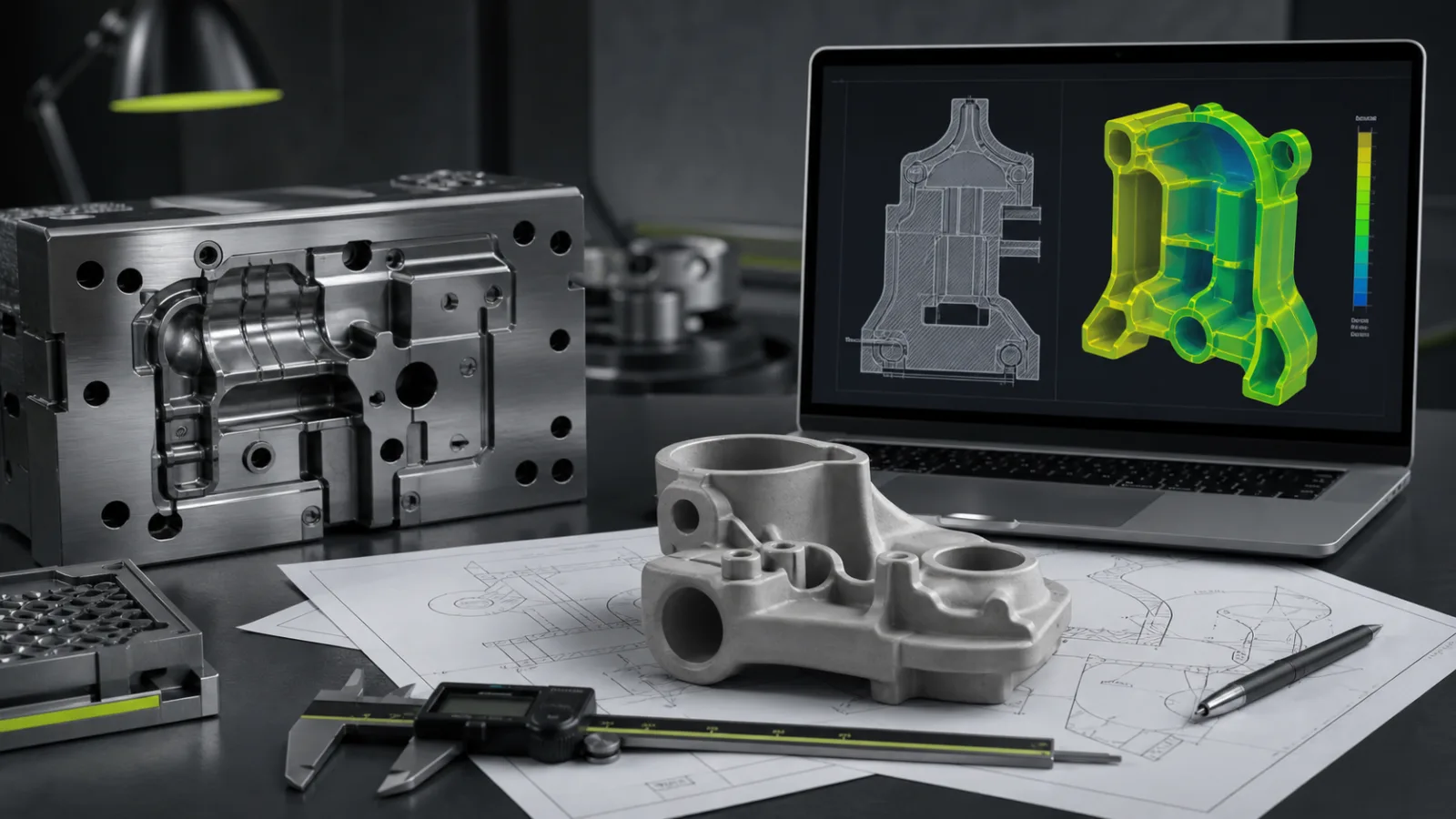
Most castings have to be fastened to something, so many of them carry at least one thread.
What is surprising is how often the thread decision is taken last, after the geometry has been locked. The options are then fewer and more expensive than they needed to be.
Two figures decide everything
Before choosing a method, answer this:
1. How many times does the screw come out again? Once at assembly and never again? At every service visit? Every time the furniture is moved?
2. At what torque is it tightened? An M4 in a cover and an M10 in a load-bearing joint are not the same problem.
Aluminium and zinc are softer than the steel screw that goes into them. Threads in soft metal wear, and they wear faster the higher the torque and the more often they are used. The whole choice is about matching the method to the load.
Method 1: Cast thread
The thread is formed directly in the tool. No post-operation.
When it works: coarse threads screwed once and left, where the tolerance requirement is low, and where the thread lies in the draw direction.
The limitations, in order:
The tolerance is a casting tolerance, not a thread tolerance. The thread comes out coarser and fits less precisely than a cut thread.
The thread has to lie in the draw direction. A thread across the opening direction is an undercut and requires either an unscrewing core or a slide core. Both are expensive, and both lengthen the cycle.
Wear. A cast thread survives a few assembly cycles, not many.
In practice cast threads are used less often than people expect, precisely because most threads are used more than once.
Method 2: Cut or formed thread
The standard choice in most cases. The hole is cored in the casting and the thread is made in the CNC machine afterwards.
A cut thread removes material as swarf.
A formed thread displaces the material into the thread profile rather than cutting it away. That produces no swarf, a stronger thread because the material structure follows the profile instead of being cut through, and longer tool life on the tap.
Zinc suits forming particularly well: the material is soft enough for the thread to form cleanly without tearing, and hard enough for it to hold under tightening. That is one reason zinc is an undervalued material for fittings and covers that will be unscrewed.
The precondition is the hole. The core hole has to be cast at the right diameter:
- Too tight gives hard tapping, high load on the tap and a risk of breaking it in the hole.
- Too large leaves the thread without enough material to bite into, and it strips at a lower torque than calculated.
Because casting tolerance is coarser than thread tolerance, the hole has to be dimensioned against the unfavourable end of the tolerance — not against an average part.
Method 3: Threaded insert
A steel thread is fitted into the part. The insert can be pressed, heat set, ultrasonically installed or screwed in.
When it is right: when the thread has to survive many disassembly cycles, when the torque is high, or when a steel bolt in soft metal would otherwise wear out the thread within the life of the product.
The cost: one extra operation and a bought-in component. The insert also needs space around the hole — that has to be allowed for in the geometry, and it is one reason the thread decision belongs before the design is locked.
How deep should the thread be?
A common question, and one where the textbook value is worth knowing.
In steel, the engagement length is often taken to be around one thread diameter. In softer materials such as aluminium and zinc it has to be considerably longer, because each thread turn carries less.
General practice is to allow substantially more engagement in light metals than in steel — and to verify it against the actual torque rather than trusting a rule of thumb. If the joint is critical, the engagement length should be calculated from bolt and material data, not assumed.
Practical consequence for the designer: the boss has to be tall enough. And a tall boss is a place where metal accumulates, which produces shrinkage porosity — so it has to be cored out from the back and tied to the wall with a rib.
Thread choice and castability are therefore directly connected.
The decision table
| Cast thread | Cut or formed | Threaded insert | |
|---|---|---|---|
| Tolerance | Casting tolerance | Thread class | Thread class |
| Survives disassembly | A few times | Many times | Most times |
| Suitable for high torque | No | Medium | Yes |
| Cost per part | Lowest | One operation | Two operations |
| Geometry requirement | Must lie in the draw direction | Requires tool access | Requires space around the hole |
| Typical use | Coarse thread, assembled once | The standard choice | Serviceable and wear-exposed joints |
Why it matters where the thread is made
The thread is where the part actually meets the customer product. If it sits 0.2 mm out of position, the part does not fit — however perfect the rest of the geometry is.
If the casting happens in one place and the threading in another, you have two suppliers when that happens. Was the hole cast wrong, or was it the fixturing in the mill? Both have a good argument that it was the other.
With us both happen in the same building, with CNC machining straight after casting. That means one point of responsibility, and a fault is spotted in house rather than in another company that has to find time to look at it.
One of our product examples is precisely this: a bracket die cast in zinc, threaded and finished here so the customer can use it directly in their own assembly. More parts of this kind are covered under fittings and threaded parts.
The terms, precisely
Three terms are used interchangeably in enquiries, and it pays to separate them. Cast-in threads are threads formed directly in the die, with no subsequent operation. Thread cutting is threading cut or formed in the CNC machine after casting. A threaded insert is a bushing in another material pressed or moulded into a cast hole. The three cost differently, take different loads and demand different things of the drawing.
What to tell us
Send the drawing with the thread size, the tightening torque and an estimate of how many times the joint will be taken apart.
With those three pieces of information we can say specifically which of the three methods is right, and whether the boss is tall enough and shaped so it does not produce shrinkage porosity. Request a quote.
- zinc
- machining
- threads
- threaded insert
- screw boss