Zinc bracket threaded in house
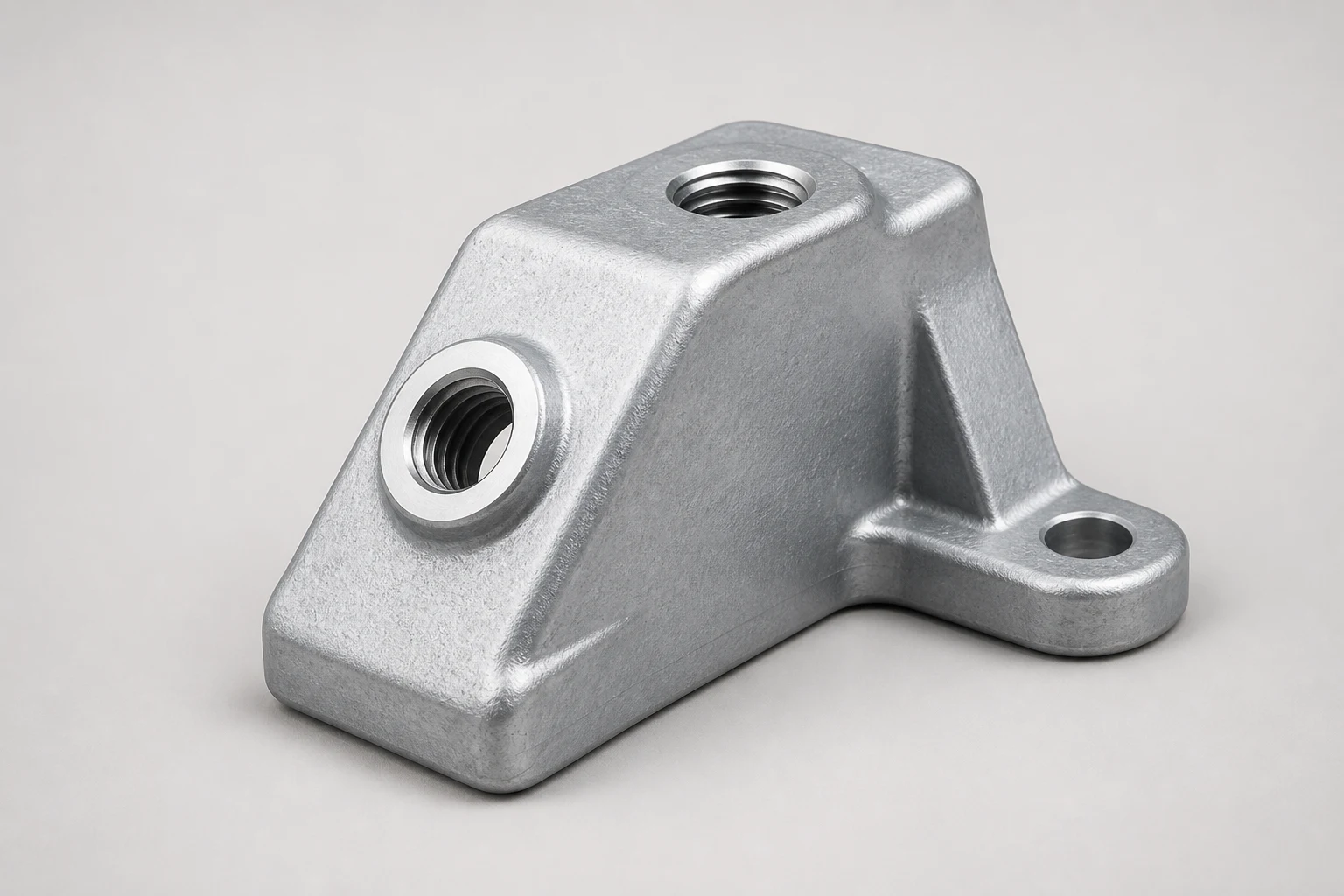
A zinc die cast bracket, threaded and finished here so the customer can take it straight into assembly. The part does not leave the building between casting and threading.
The challenge
The bracket is a joining part. Its entire purpose is to connect two other parts, and all the value sits in the interfaces: the threads, the hole positions and the seating face.
That creates a precision conflict. Casting alone does not give thread tolerance. A cast thread is coarse, must lie in the draw direction, and does not survive many disassembly cycles. If the thread needs the correct class and has to sit exactly where the drawing says, it must be cut or formed after casting.
A common solution is for a foundry to cast the part and send it to a machine shop. The customer then has two suppliers, two lead times, two freight legs and a grey zone of responsibility when a thread comes out of tolerance. Was it the position in the casting, or was it the fixturing in the mill?
Here the customer needed to take the part straight into their own assembly.
The solution
Zinc die casting, then threading and finishing in the same building.
Why zinc. Zinc is the right material for a part where the interfaces decide. It reproduces detail more sharply than aluminium, holds dimensions better, and takes threads particularly well: soft enough for the thread to form cleanly, hard enough to hold under tightening. The lower casting temperature also gives substantially longer tool life — and since the customer owns the tool, that lands directly in the customer economics.
Why casting and machining in house. This is the point of the example:
- The part does not travel. No freight between foundry and machine shop, no waiting in two queues, no packing twice.
- One point of responsibility. If the hole is wrong, it is ours, whether the error arose in the tool or in the mill. The customer does not have to mediate between two suppliers.
- A shorter way back. If we see in the threading operation that a hole is consistently out of position, the message goes straight back to casting, not to another company.
- The design can be optimised across both steps. We can core the holes in the casting and leave exactly the machining allowance needed — no more. Less allowance is less swarf, shorter machining time and a lower price per part.
Datums are set from the seating face, not from the outer edge of the part. A casting has draft on every external face, and a dimension taken from there is a dimension taken from nothing.
The result
The customer receives an assembly-ready part. No incoming inspection of semi-finished castings, no internal forwarding, no separate purchase order to a machine shop.
An entire transport and queueing step is gone. The customer has one supplier to follow up instead of two, and the complaint route is a single conversation.
This is the example that best shows what we mean by casting and machining in house. It is not about the machine park, but about how many links the customer no longer has to follow up. More on parts like this under fittings and threaded parts.
Zinc because the interfaces decide and the material takes threads cleanly. High pressure die casting because the geometry is complex and the series runs over time. In-house machining because the value in this part lies in something casting alone cannot deliver — and because the part then does not have to travel.
More case studies
Mobility aids
Bracket for the mobility aid industry
A load-bearing bracket, high pressure die cast in aluminium, for wheelchairs and walking aids. The part must be light enough for the user to lift the device, and strong enough to carry the user.
Garden equipment
Bracket for garden equipment
An aluminium die casting for consumer volumes, cast with the bearing fit and pressure tightness straight from the tool — with no subsequent machining.
Gravity die cast bracket, heat treated
A load-bearing bracket where the strength requirement exceeded what high pressure die casting can deliver. The part is gravity cast precisely because it will be heat treated afterwards — the method follows the function, not machine availability.