Mobility aids
Bracket for the mobility aid industry
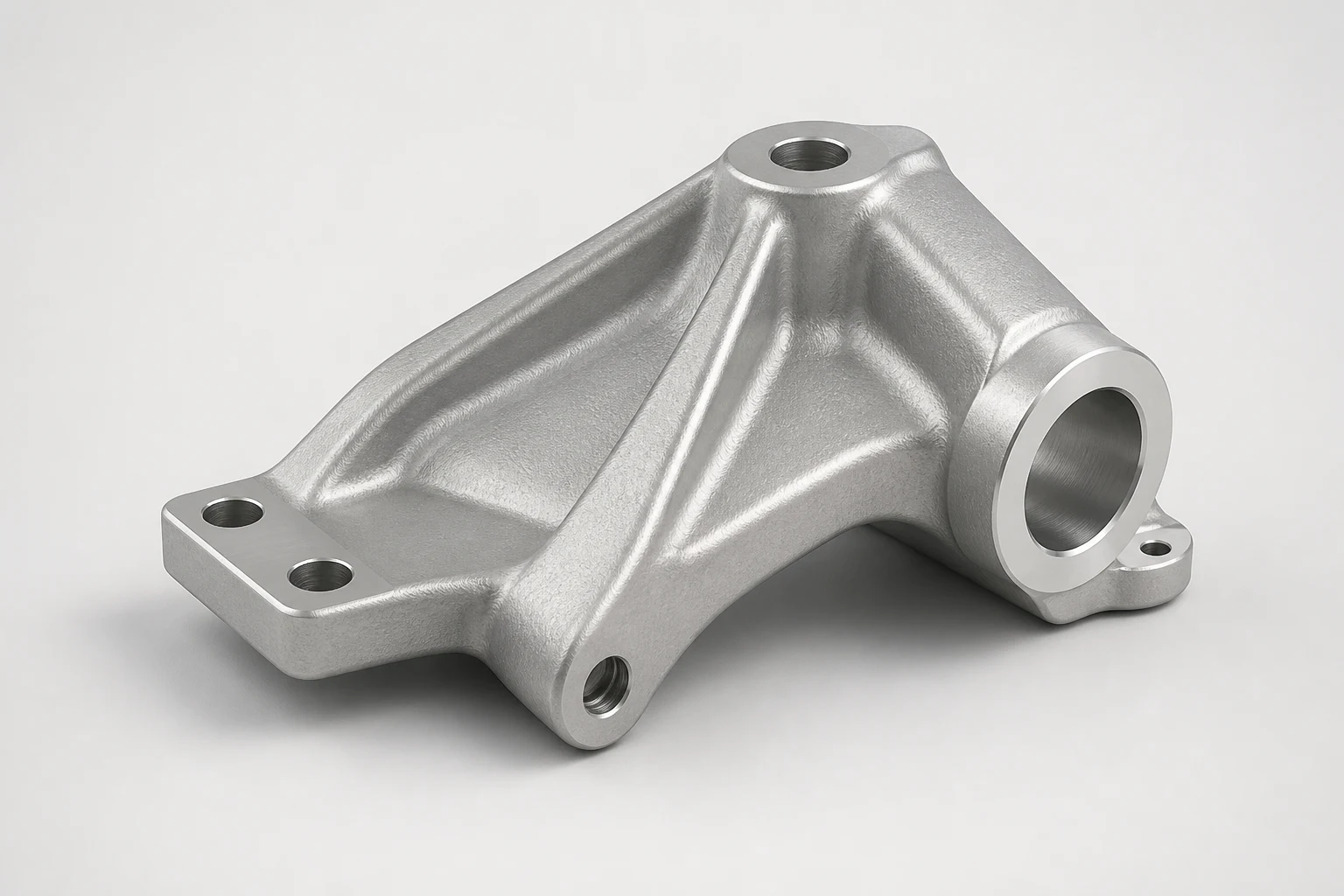
A load-bearing bracket, high pressure die cast in aluminium, for wheelchairs and walking aids. The part must be light enough for the user to lift the device, and strong enough to carry the user.
The challenge
Two requirements pulling in opposite directions, in the same part.
The bracket sits in a mobility aid that has to carry an adult through tens of thousands of load cycles over many years. At the same time, that same user has to be able to lift the device into a car. Every hundred grams matters in daily life.
The load is cyclic, not static. That means the part does not fail from a single overload — it fails after many cycles, and the fracture starts wherever there is a pore or a sharp internal corner. Ultimate strength is therefore not the decisive figure here. Fatigue is, and fatigue is a geometry contest as much as a material contest.
The solution
High pressure die casting in aluminium, with the geometry designed around the load path.
The material choice follows from the weight requirement. Aluminium has roughly a third of the density of steel. In a part that is lifted daily this is not a marginal advantage, it is the entire reason the part is in aluminium.
The method choice follows from the wall thickness and the volume. High pressure die casting handles thin sections and complex geometry in seconds per shot. That makes it possible to lay down a thin, even shell with ribs where the bending moment is high, rather than a thick block everywhere.
The design moves that make a part like this both lighter and stronger, and that we look for when we review the drawing:
- Metal removed where the stress is low, ribs added where the bending moment is high.
- Radii in every internal transition. A sharp corner in a cyclically loaded part is a fatigue crack waiting to start.
- Gates and overflows placed so the metal solidifies the right way in the sections that actually carry. That is where freedom from porosity matters — not everywhere.
- Hole positions set from the seating face rather than the outer edge, so bolt preload comes out right.
The result
A load-bearing part in series, with the same geometry and the same hole positions in every single unit.
That repeatability is what keeps the customer assembly line running, and what makes the spare part supplied in five years fit a device built this year.
The customer owns the tool. It sits in Råde, we maintain it, and the series can keep running for as long as the product lives.
High pressure die casting because the wall is thin, the geometry complex and the volume large enough to carry the tooling cost. Aluminium because weight is a functional requirement, not a preference. Not gravity casting, because the part does not need heat treatment to reach the strength requirement.