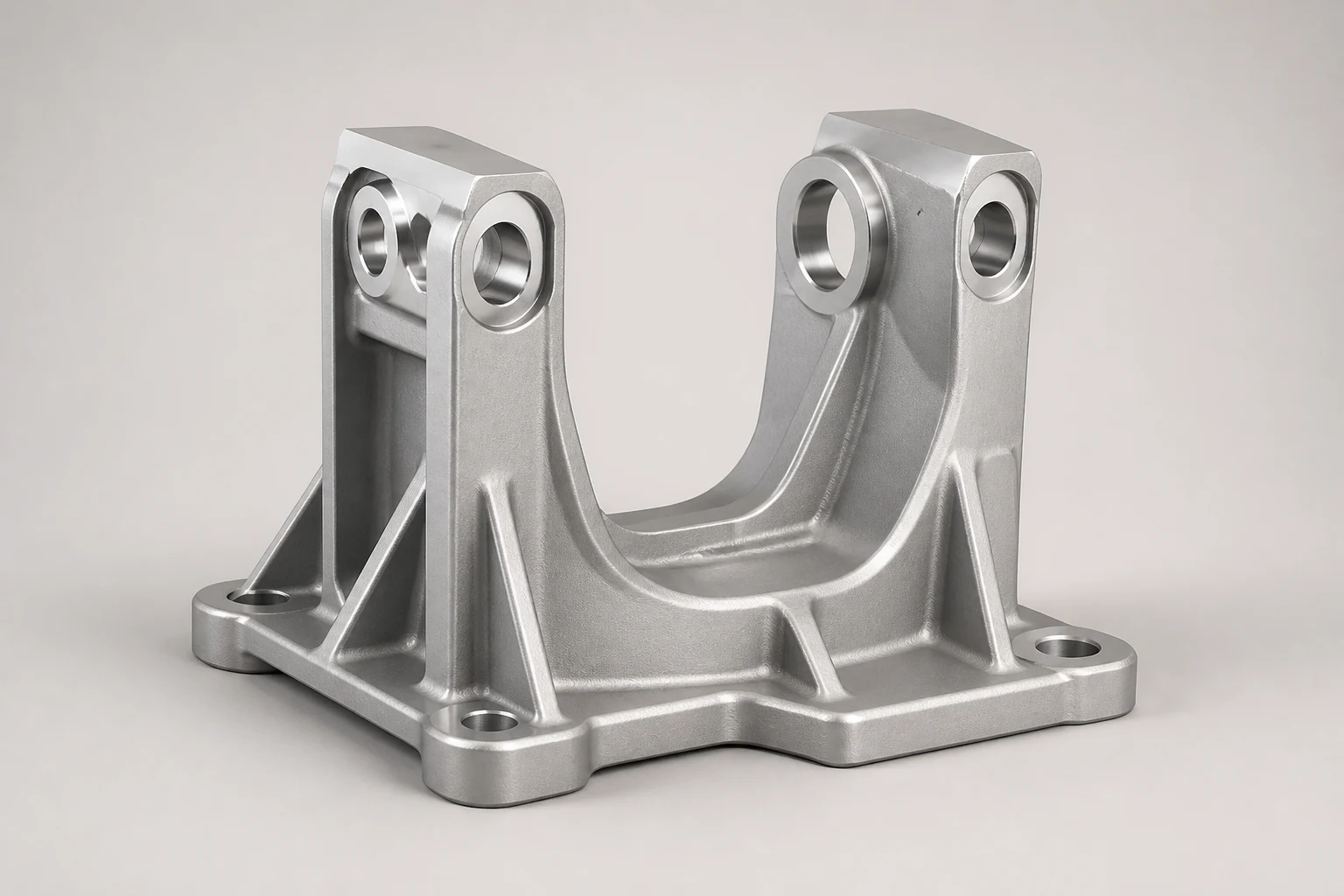
Gravity die cast bracket, heat treated
A load-bearing bracket where the strength requirement exceeded what high pressure die casting can deliver. The part is gravity cast precisely because it will be heat treated afterwards — the method follows the function, not machine availability.
The challenge
The customer needed higher tensile and ultimate strength than a high pressure die casting could deliver.
That is an entirely ordinary situation, and it exposes a technical limit most people do not know about: high pressure die castings normally cannot be heat treated.
The reason sits in the process itself. In high pressure die casting the melt is injected into the die under high pressure and the cavity fills in milliseconds. Some air does not get out and is trapped in the section as finely distributed porosity. In normal service that matters little. But in a solution treatment — where the part is held near 500 degrees for hours — the trapped gas expands. The result is blisters under the surface and a part that is scrap.
That creates a genuine dead end: the method that is fastest, cheapest per part and best at thin walls is also the method that closes the door on the heat treatment the customer needs.
So the choice was not “which machine happens to be free”. It was: what does the part have to withstand, and which process chain can deliver it?
The solution
Gravity die casting, followed by heat treatment.
Why gravity casting opens the door. In gravity die casting the melt runs into a permanent metal mould under gravity. The fill is calm, it takes seconds instead of milliseconds, and the air has time to escape. The section is sounder and does not contain the trapped gas that causes blistering. That is why a gravity cast aluminium part survives a solution treatment.
What the heat treatment does. In a heat-treatable aluminium alloy the strengthening elements are dissolved into the matrix at high temperature. The part is quenched so they stay in solution, then aged under control. During ageing fine particles precipitate that obstruct dislocation movement through the material — and that mechanism is what raises yield and tensile strength. This is not surface hardness. It is strength through the full section.
What you pay for it. Nothing is free:
- A longer cycle. Gravity casting takes minutes per shot, die casting seconds. That feeds straight into price per part.
- Thicker walls. Gravity casting needs more material in the walls than die casting. The part gets heavier.
- A rougher surface. More often requires finishing if appearance matters.
- One more process step. Heat treatment is time, energy and another handling operation.
In return: lower tooling cost, and gravity die casting pays off at considerably smaller series than die casting. Where die casting typically needs a few thousand parts a year to carry the tool, gravity die casting typically manages on a fifth to a tenth of that.
The result
A load-bearing part that is heat treated after casting and gains higher tensile and ultimate strength.
The most important thing about this example, though, is not the part. It is the decision behind it.
A foundry with only one process will naturally recommend that process. If all you have is die casting machines, the answer to a strength requirement becomes “we can add a bit more metal”. That rarely works, and it makes the part heavier and more expensive without solving the problem.
We have both. That means we can say “this one should not be die cast” — and explain why, with a technical justification the customer can check.
If you are sitting with a part where strength is the critical requirement, this is the conversation to have before the tool is ordered. A gravity die and a high pressure die are not the same tool, and the choice is expensive to reverse.
Gravity die casting because the part is to be heat treated, and high pressure die castings normally do not survive solution treatment — trapped gas causes blisters. Heat treatment because the strength requirement exceeded the as-cast condition. Aluminium because the alloy has to be heat treatable for the mechanism to work at all.
More case studies
Mobility aids
Bracket for the mobility aid industry
A load-bearing bracket, high pressure die cast in aluminium, for wheelchairs and walking aids. The part must be light enough for the user to lift the device, and strong enough to carry the user.
Zinc bracket threaded in house
A zinc die cast bracket, threaded and finished here so the customer can take it straight into assembly. The part does not leave the building between casting and threading.
Garden equipment
Bracket for garden equipment
An aluminium die casting for consumer volumes, cast with the bearing fit and pressure tightness straight from the tool — with no subsequent machining.