Zinc
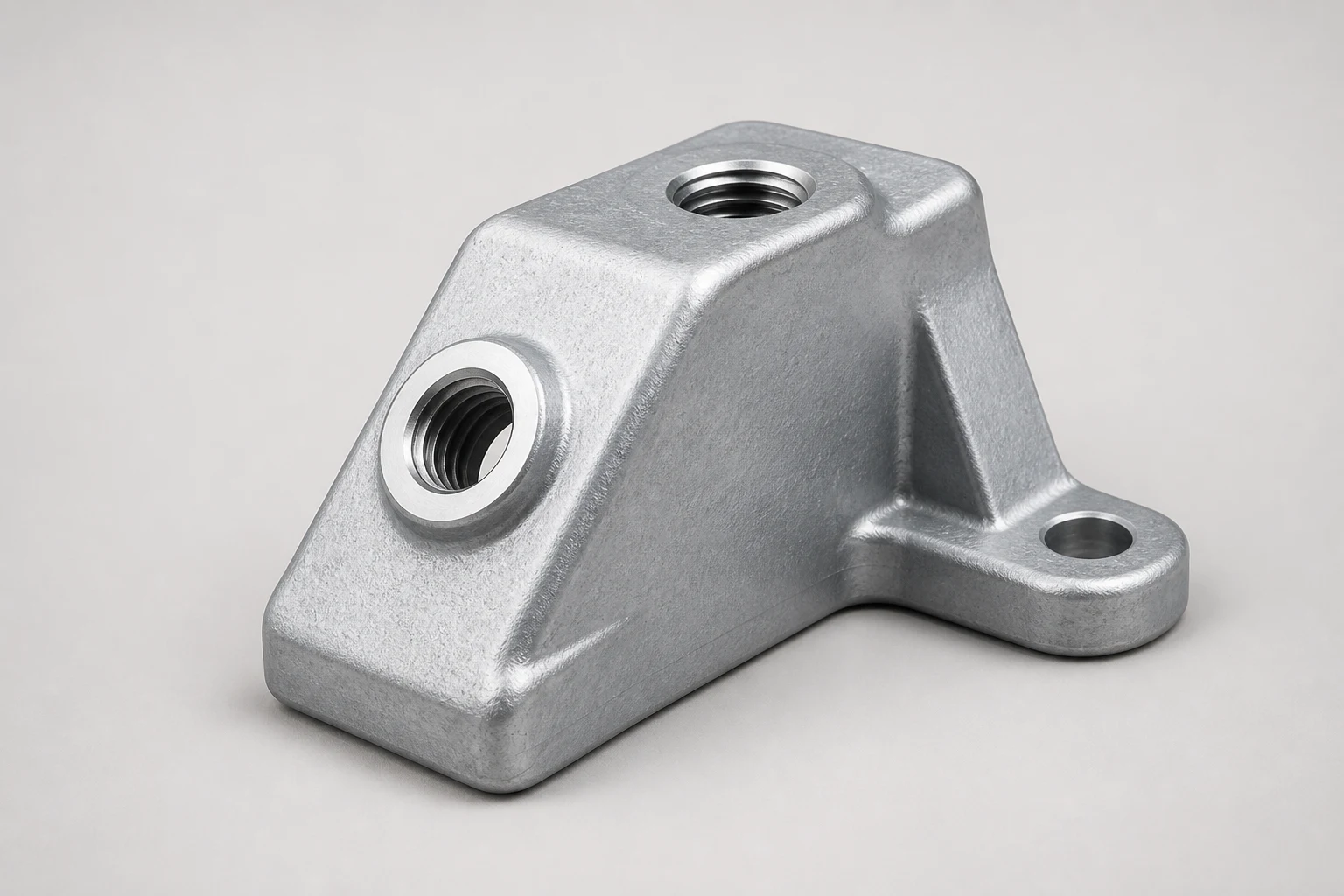
Zinc bracket threaded in house
A zinc die cast bracket, threaded and finished here so the customer can take it straight into assembly. The part does not leave the building between casting and threading.
Casting and machining in Råde. Surface finishing coordinated by us.
Fittings and other parts that hold two things together, cast in zinc or aluminium and threaded in house. The value sits in the interfaces: the threads, the holes and the seating faces.
We cast fittings to the customer’s drawing, in zinc or aluminium, and thread and machine them in house, so the part can go straight into your assembly. Two of our product examples show exactly this: a zinc bracket threaded and finished here and a zinc furniture bracket.
A fitting has no function of its own. It exists only to hold two other things together. All its value therefore sits in the interfaces, and this type of part tolerates less slop than any of the other three.
The practical consequence is that dimensions should be set from the seating face, not from the outer edge of the part. A casting has draft on every external face. Measure the hole from the outer edge and you are measuring from a face that is not perpendicular to anything. Measure from the seating face and you are measuring from the face that actually meets the part it is fixed to.
Cast thread. Possible, but only coarse threads and only where the parting line allows it. The tolerance is a casting tolerance, not a thread tolerance. It rarely suits anything that will be unscrewed again.
Cut or formed thread. The standard choice. The hole is cast with a core, and the thread is cut or formed in the CNC machine afterwards. That gives the correct thread class and a position that repeats from part to part. Zinc takes threads well: soft enough to form cleanly, hard enough to hold.
Threaded insert. When the thread must survive many disassembly cycles, or when a steel bolt in soft metal is a problem. It costs one extra operation.
Which of the three fits depends on how many times the screw comes out again, and on the tightening torque. Send us both figures and you get a concrete answer. There is more on the choice in threads in cast parts.
We review the drawing before the tool is ordered: which threads are to be cut, where the machining allowance goes, and which faces the dimensions are taken from. We procure the tool, and you own it. Casting, threading, machining and blasting happen here. If the fitting is to be coated, a sub-supplier does it, and we order and follow up that step. The whole chain is described in from drawing to assembly-ready part.
What do you need to quote? The drawing with thread sizes, quantities per order and per year, and how many times the part has to be taken apart. Request a quote.
A zinc die cast bracket, threaded and finished here so the customer can take it straight into assembly. The part does not leave the building between casting and threading.
Furniture
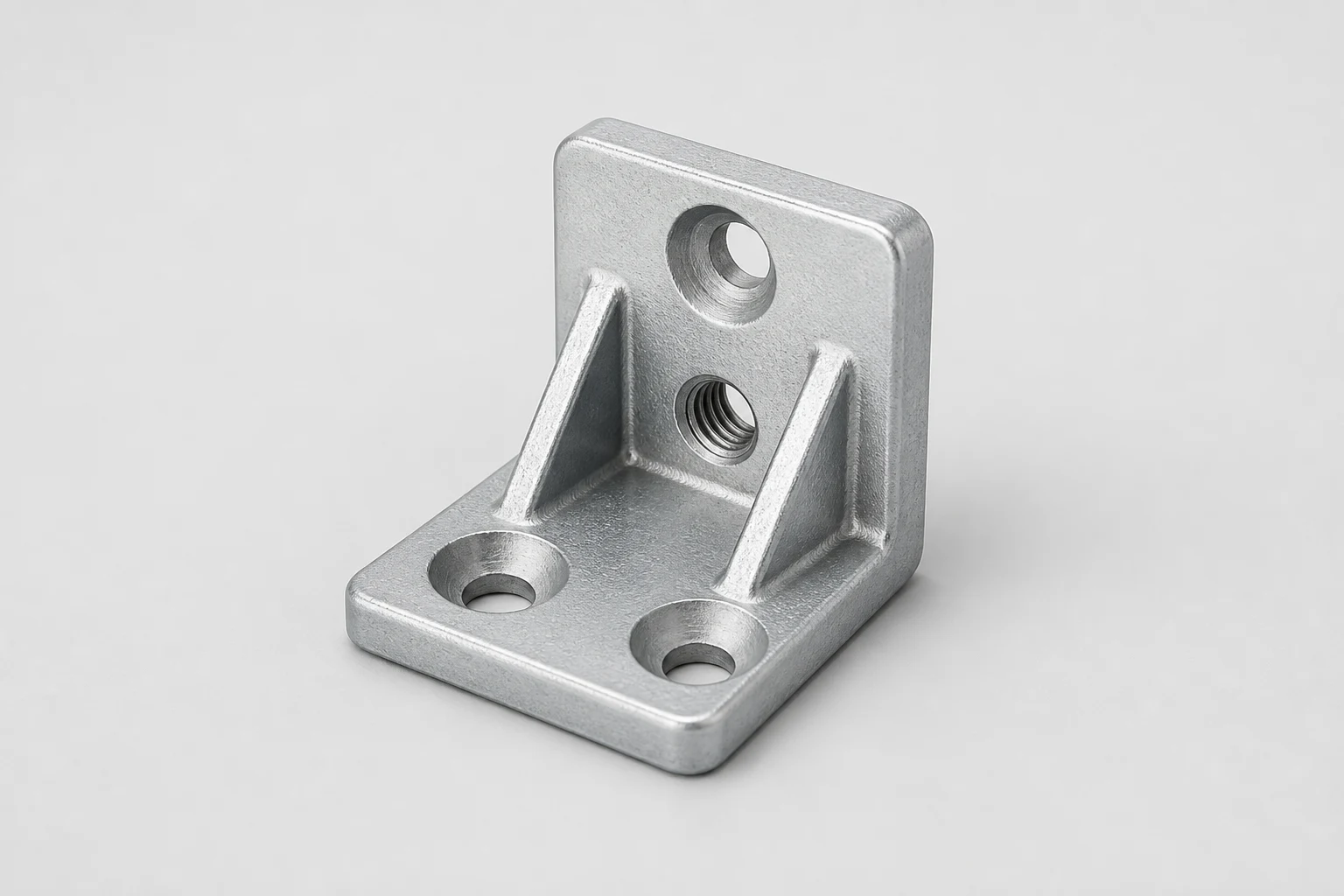
A joining fitting die cast in zinc. It has to hold two furniture parts together through repeated assembly and disassembly, and feel solid in the hand when the customer unpacks it.
Fittings and threaded parts
| Criterion | Cast thread | Cut or formed thread | Threaded insert |
|---|---|---|---|
| Tolerance | Casting tolerance — coarse | Thread class | Thread class |
| Survives disassembly | A few times | Many times | Most times |
| Cost per part | Lowest | One operation | Two operations |
| Limitation | Must lie in the draw direction | Requires tool access | Requires space around the hole |
The thread sizes we currently run are stated on request.
A zinc die cast bracket, threaded and finished here so the customer can take it straight into assembly. The part does not leave the building between casting and threading.
Furniture
A joining fitting die cast in zinc. It has to hold two furniture parts together through repeated assembly and disassembly, and feel solid in the hand when the customer unpacks it.
Send the drawing with thread size and tightening torque, and we will tell you whether the thread should be cast, cut or inserted.
Send the drawing and a rough quantity. We look at the part before we work out a price.
We count visits anonymously to make the website better. Google Analytics only loads if you say yes. Read more