Furniture
Zinc furniture bracket
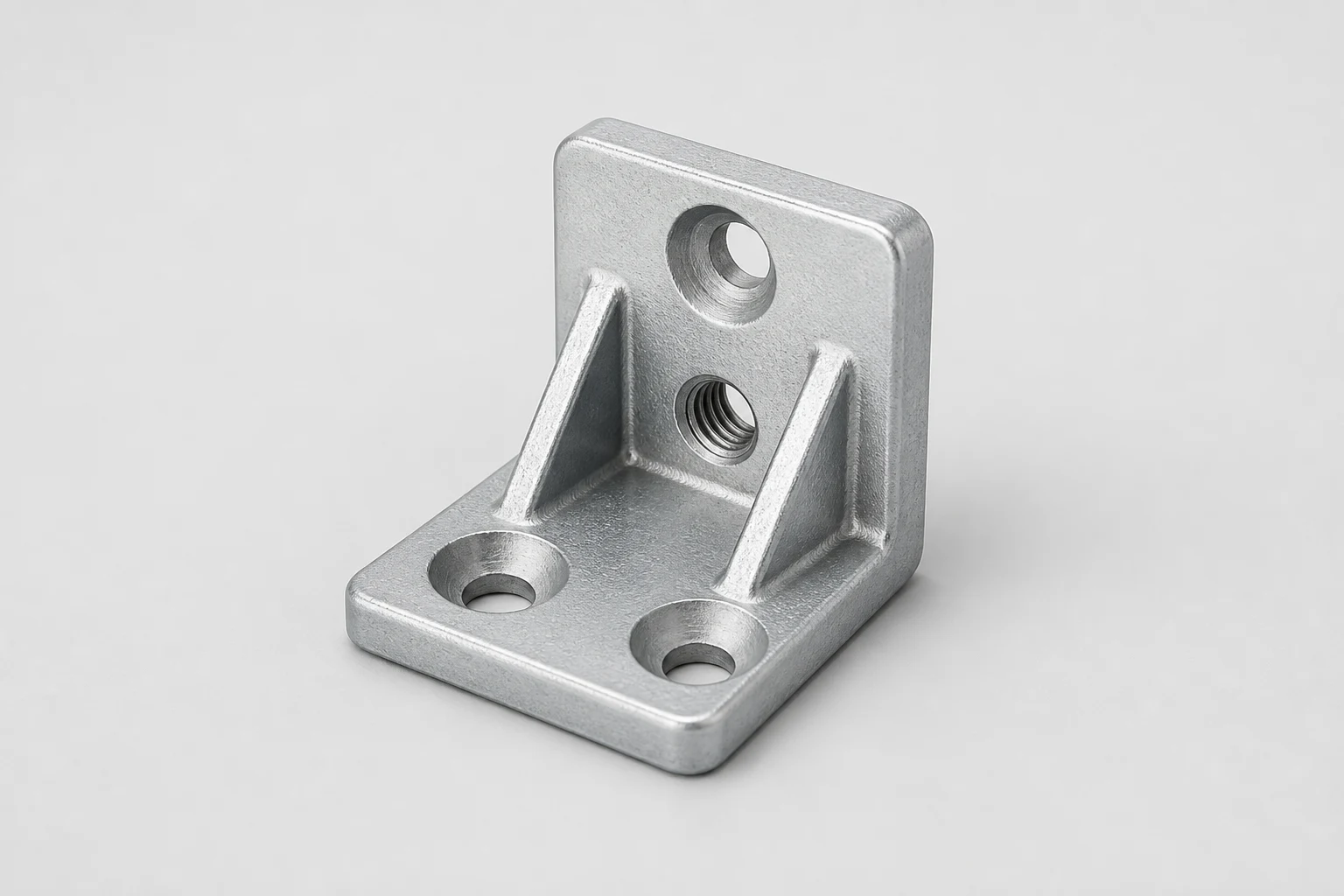
A joining fitting die cast in zinc. It has to hold two furniture parts together through repeated assembly and disassembly, and feel solid in the hand when the customer unpacks it.
The challenge
A furniture fitting has two jobs that have nothing to do with each other.
The mechanical job: holding two parts together. That sounds simple, but furniture is assembled, moved, taken apart and assembled again. The thread has to survive that, and the seating face has to be flat enough that the fitting does not twist as the screw is tightened.
The perceived job: feeling right. The end user takes the fitting out of the bag, weighs it in the hand and forms an opinion about the furniture before it is assembled. A light, thin fitting reads as cheap, no matter how well it works.
Above both of these sits a third reality: the segment is price-pressured, and the benchmark is an imported part.
The solution
Zinc die casting — the material that solves both jobs at once.
Mechanically: zinc takes threads well. It is soft enough for the thread to form cleanly without tearing, and hard enough to hold under tightening. That makes it possible to put threads directly into the fitting rather than using an insert or a nut, both of which are an extra part and an extra operation.
Perceptually: zinc weighs more than aluminium. In the hand that reads as solidity. Here density is a product property, not a technical drawback.
Surface: zinc die casting usually gives a fine surface straight from the tool. The parting line goes where the fitting is not seen after assembly, and the ejector points on the back.
Tool economics: a zinc tool survives substantially more shots than an equivalent aluminium tool, because zinc is cast at a much lower temperature. For a furniture manufacturer who owns the tool and will sell the same range for years, this part of the calculation can matter more than the unit price.
The result
A fitting that works mechanically, feels right and can be produced in series from a tool that lasts.
We should be honest about the competitive picture: on a simple fitting in large quantities an importer will often beat us on price per part. Claiming otherwise does not help.
What we can offer in this market is a short run, tooling that stays in Norway, one point of contact and a fitting that can arrive threaded. How batches and call-offs can work is settled in the quotation. If none of that is worth anything to you, we are probably the wrong supplier, and it is better to establish that in the first conversation than after three rounds of quotations. See also the furniture industry page.
Zinc because the material delivers thread quality, surface finish and perceived weight in the same part. High pressure die casting because the geometry is complex and the series runs for years. Zinc tool life is also a direct customer argument when the customer owns the tool.
More case studies
Furniture
Furniture fitting, machined and coated
A visible fitting that is cast, machined, blasted, coated at a sub-supplier and inspected before delivery. Nine steps, with the coating and the transport there and back running through the sub-supplier. We follow up all nine.