Furniture
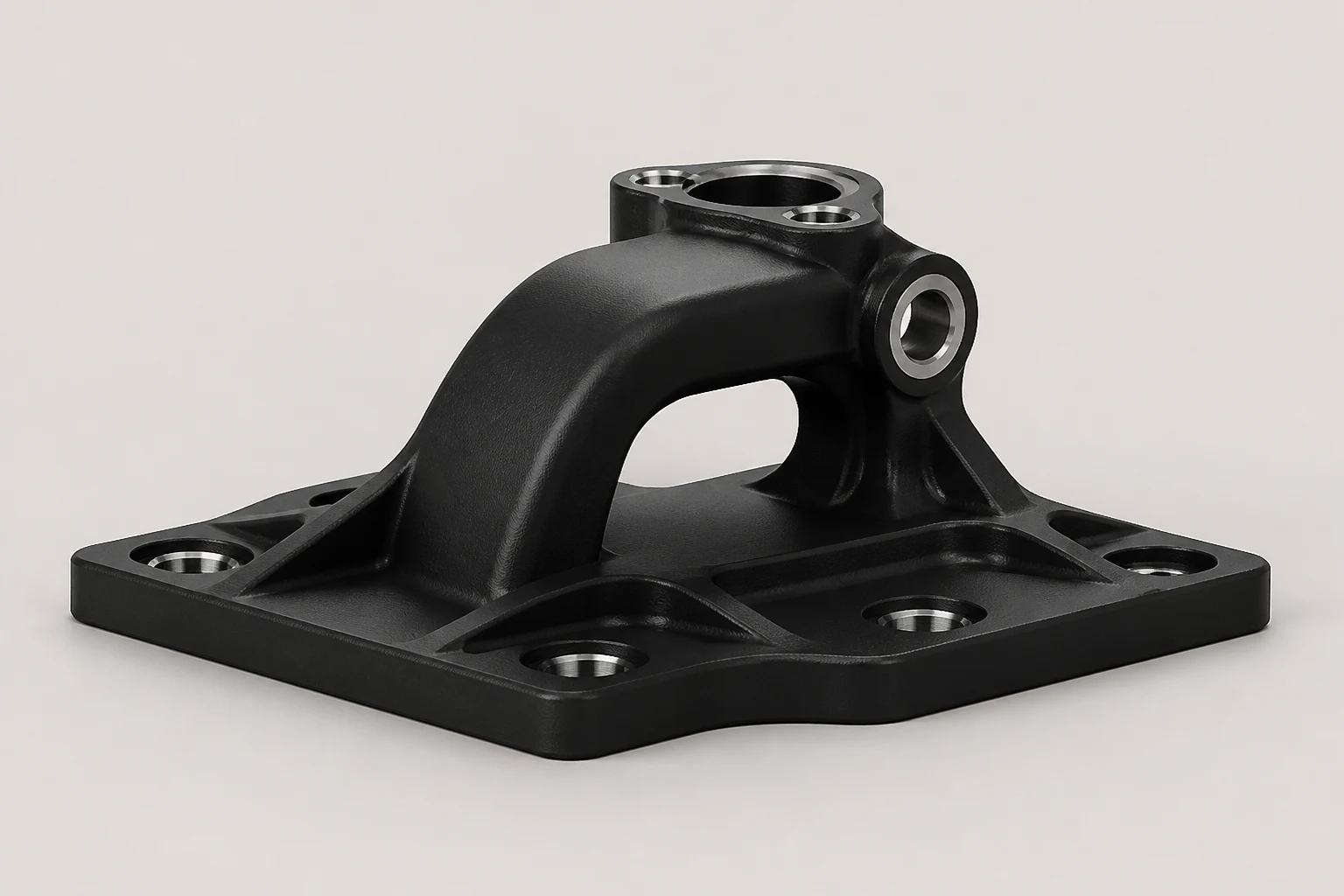
Furniture fitting, machined and coated
A visible fitting that is cast, machined, blasted, coated at a sub-supplier and inspected before delivery. Nine steps, with the coating and the transport there and back running through the sub-supplier. We follow up all nine.
The challenge
This is the longest process chain we run, and every step is a place where something can go wrong.
Aesthetics is a tolerance. On a visible fitting the defect is not measured — it is seen. The parting line cannot sit in the field of view. The ejector marks cannot sit on a face anyone looks at. Flow marks and cold flow in the surface are defects even when the part is dimensionally perfect.
The requirement is hard to write down. “A nice surface” is not a specification. Without an agreed reference, such as an approved sample, a colour code or a surface standard, the acceptance discussion becomes a matter of taste after a whole series has been coated.
The finishing step is outside the building. We do not do anodising or powder coating ourselves. That means one transport out, one back, and another supplier who has to get it right.
The colour has to hold over years. The fitting delivered in year five must match the one delivered in year one.
The solution
The decisions are made before the tool is designed, and we follow up the whole chain.
Before the tool: the customer marks the visible faces on the drawing. We place the parting line and the ejector points outside them. This is not something that can be corrected later — it is built into the tool.
The reference is agreed: colour in RAL or NCS with a permitted deviation, and an approved sample as the standard. Without that there is no objective acceptance test.
The chain in practice:
- Casting, with the parting line where it belongs.
- Fettling — runners, overflows and flash removed.
- Machining of faces and holes needing tighter tolerance than casting delivers.
- Blasting in house. Gives an even matte surface for the coating to key into, and removes small casting marks.
- Transport to the coating supplier.
- Coating or anodising.
- Transport back to Råde.
- Inspection of colour and surface against the reference.
- Packing that lets the visible face survive transport to the customer.
We follow up the external step. We order the coating, follow it up and take it up with the coater when something deviates. The customer deals with us, including when the colour is off. What is done in house and what is done elsewhere is described under surface finishing.
The result
A finished, coated part that goes straight into packaging at the customer.
The honest caveat: the external finishing step adds transport and a few days to the lead time. That is a real cost in calendar time, and we state it in the quotation rather than hiding it.
In return the customer has one supplier through the whole chain. There are nine steps where something can go wrong, and you deal with one point of contact for all nine.
This example also shows clearly why “positive product criticism” is more than a technical review. The decision about where the parting line goes is cosmetic, commercial and technical at once — and it has to be made before anyone starts building the tool.
Casting because the freedom of form a visible part requires is expensive in sheet and cheap in casting, and because the surface comes straight from the tool. Machining because some dimensions are tighter than casting can hold. Coating at a sub-supplier because we do not coat in house — and we say so plainly.
More case studies
Furniture
Zinc furniture bracket
A joining fitting die cast in zinc. It has to hold two furniture parts together through repeated assembly and disassembly, and feel solid in the hand when the customer unpacks it.