Process
Machined castings: from drawing to assembly-ready part
A casting is not finished when it leaves the tool. Here are the steps to an assembly-ready part, who carries them out, including finishing at a sub-supplier, and where the responsibility lies.
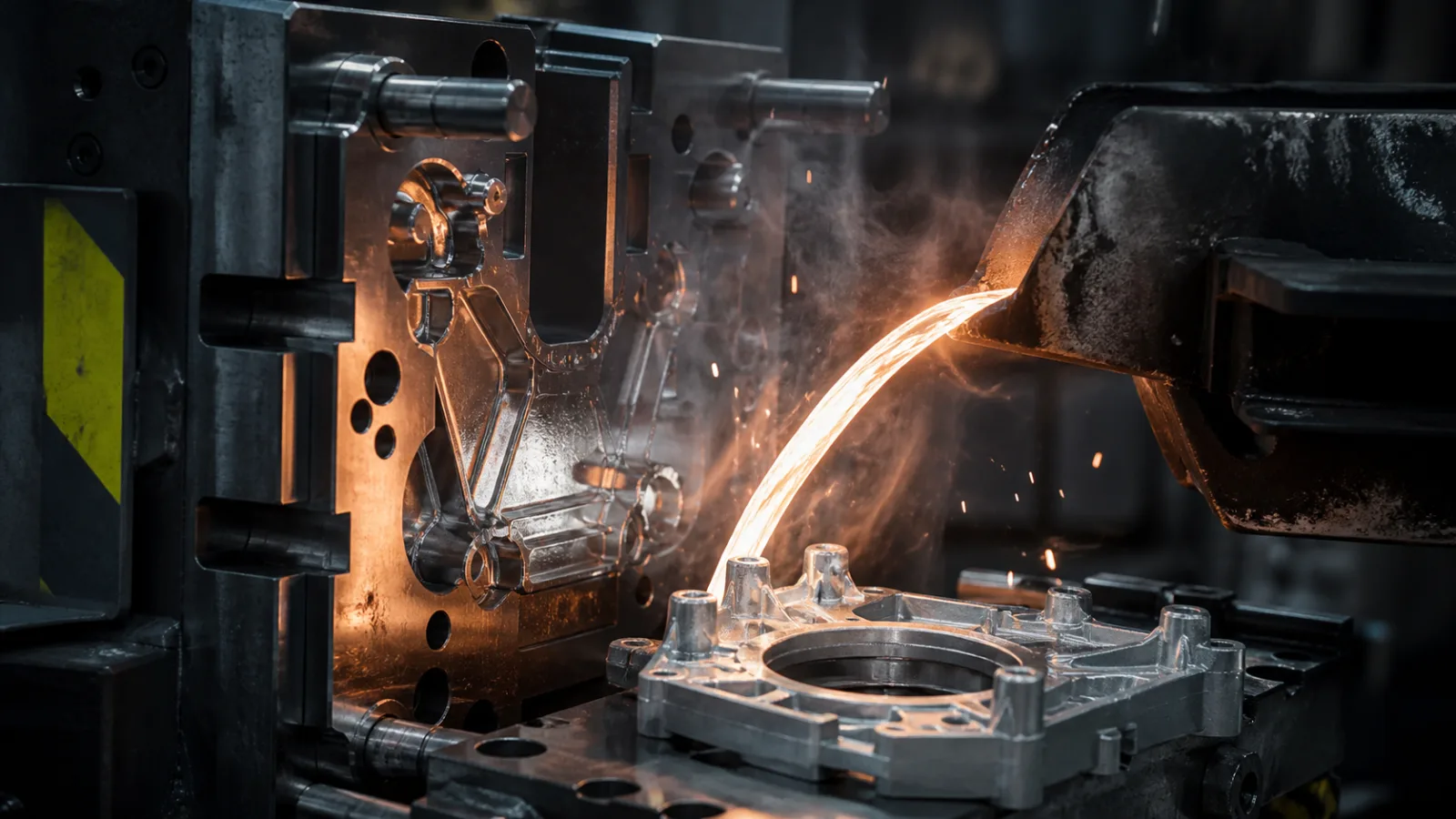
A casting is not finished when it comes out of the tool. It is still attached to the runner system, carries overflows and flash along the parting line, and has faces that are too rough or too imprecise to meet the part it will be assembled to. Between drawing and assembly-ready part there are several steps. This article is about who does what, and where the responsibility lies when something goes wrong.
The steps, and who does them
| Step | What happens | Who does it |
|---|---|---|
| Drawing and requirements | Drawing, quantities and functional requirements | You |
| Design review | Wall thickness, draft angles, radii, parting line and tolerances are reviewed | Us |
| Casting tool | Designed for our machines and made by a tool supplier. You own the tool | Tool supplier, ordered and followed up by us |
| Casting | Die casting in aluminium or zinc, or gravity die casting in aluminium | Us |
| Fettling | Runners, overflows and flash are removed | Us |
| Heat treatment | Only for gravity die cast aluminium parts that need higher strength | Part of our delivery |
| Machining | Faces and holes needing tighter tolerance are milled, turned or bored, and threads are cut | Us |
| Blasting | An even, matte surface | Us |
| Anodising or powder coating | Anodising applies to aluminium only | Sub-supplier, ordered and followed up by us |
| Inspection, packing and dispatch | Against the drawing and the agreed reference, packed so visible faces survive transport | Us |
That is how we have organised the chain. Ask any supplier the same question: which steps do you do yourselves, and which are outsourced?
Where the responsibility lies
You have one agreement and one point of contact with us through the whole chain, including the steps done elsewhere. We order the tool and the surface finishing, follow them up and take it up with the sub-supplier when something deviates. You do not need separate agreements with the toolmaker or the coater.
The honest caveat is that the part leaves our building for the finishing step. That means one transport out, one back, and a few extra days of lead time. How many is stated in the quotation. What is done in house and what is done elsewhere is described under surface finishing.
What it costs to split the steps between suppliers
A common model is that a foundry casts and a machine shop machines. That can look cheaper on paper, because each operation is bought where it is cheapest. The arithmetic changes once the interfaces are included:
- Lead time. Every handover means packing, transport, receiving and a queue at the next supplier.
- Tied-up capital. The part is work in progress while it waits in a queue.
- Incoming inspection. The castings have to be checked before they are sent on, or you machine scrap.
- Administration. Two purchase orders, two delivery schedules, two invoices and two complaint routes.
- The grey zone of responsibility. A thread is 0.2 mm out of position. Was the hole cast wrong, or was it the fixturing in the mill? With two suppliers, each has a good argument that it was the other, and the problem stays with you.
What becomes possible when casting and machining are planned together
The machining allowance can be optimised. When casting and CNC machining are planned together, the allowance goes where it is needed, and no more. Less allowance means less swarf, shorter machining time and a lower part price.
Faults are caught early. If the threading operation shows a hole consistently out of position, the message goes straight back to casting, not to another company.
Fixturing can be designed into the casting. Datum faces and clamping points for machining can be cast in deliberately, rather than improvised by whoever receives a box of parts.
One of our product examples is a zinc die cast bracket threaded and finished here, so the customer can fit it directly.
The documentation that travels with the part
An assembly-ready part is not finished until the paperwork is. Four terms recur in supplier assessments: first article inspection (FAI) of the first parts from a new tool, measurement on a coordinate measuring machine (CMM), a material certificate to EN 10204 and traceability from the finished part back to melt and batch. If the part has to be pressure tight, that has to be tested, not assumed, and if it is bolted together, thread cutting decides whether the thread holds its dimensions. Which documentation you need, and what we can provide for your part, is settled in the enquiry.
Two lead times
Lead time is two different figures that are often mixed up. Tooling lead time runs from order to first approved sample part. Series lead time runs from call-off to delivery once the tool exists. Always ask for both, and whether the external steps are included in the second figure. A promise of “two weeks” that leaves out the coating is not a promise of two weeks.
What to clarify in the enquiry
- Which faces are to be machined, and which are visible.
- Surface finishing and colour reference.
- The documentation you need.
- Quantities per order and per year.
We can then plan the whole chain in one go, and you have one point of contact for every step. Request a quote, or read more about contract manufacturing to your drawing.
- contract manufacturing
- machining
- lead time
- process chain