Process
High pressure or gravity die casting — decision guide
One question settles the choice in most cases, and it is not about quantity. Here is the decision tree, the technical reason behind it, and the information that decides which method we recommend.
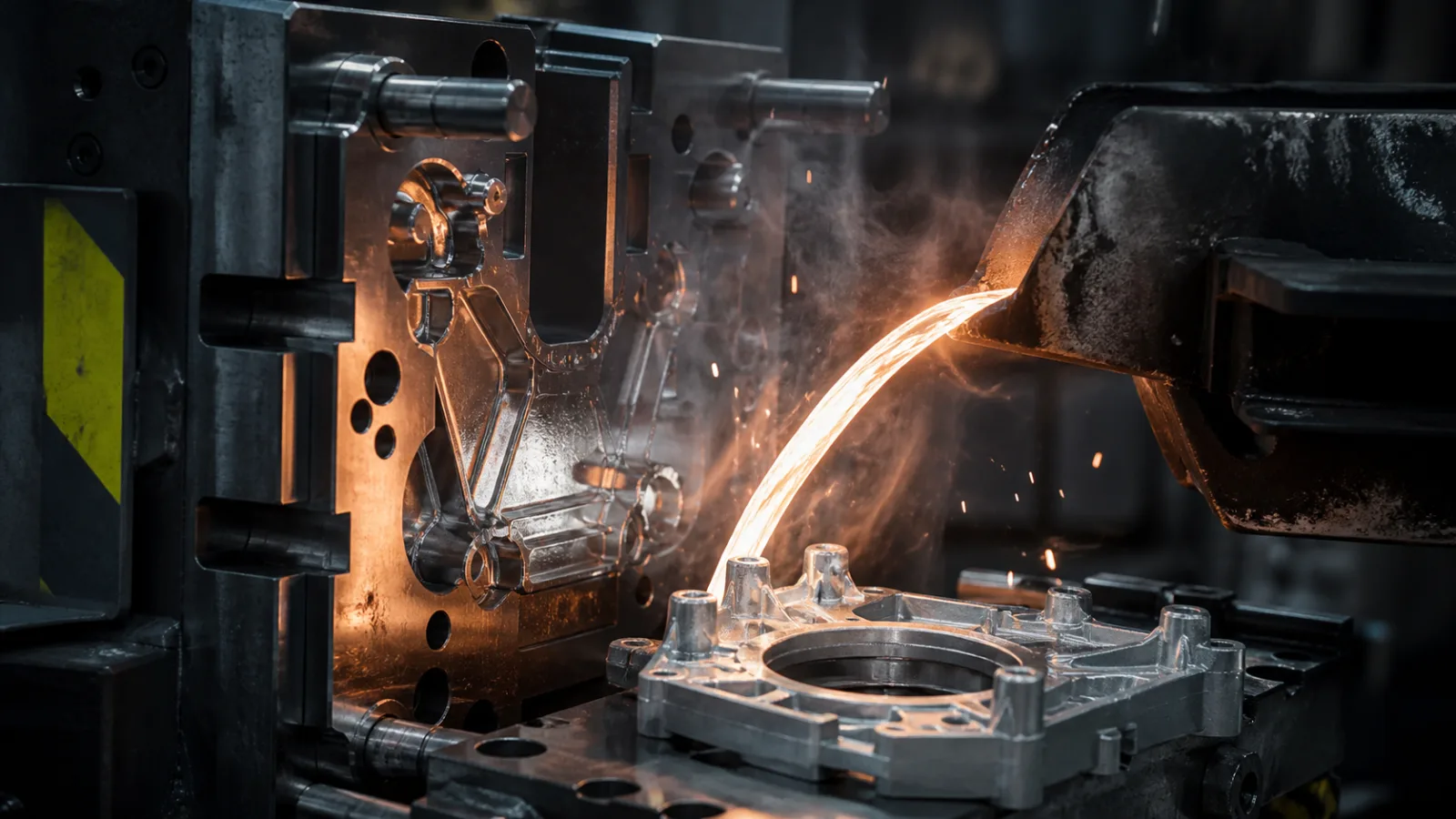
Most comparisons between high pressure and gravity die casting start with volume. That is the wrong place to start, and it leads to the wrong decision more often than people think.
Start here instead: does the part need heat treatment?
The services are described under aluminium die casting and gravity die casting. If you are unsure which fits, aluminium casting starts with exactly that choice.
Why that question comes first
In high pressure die casting the melt is injected into the die under high pressure and the cavity fills in milliseconds. It is precisely that speed that gives the method its strengths: thin walls, complex geometry and cycle times in seconds.
But the fill is so fast that the air in the cavity does not entirely escape. Some gas is trapped in the section as finely distributed porosity. In normal service that matters little.
In a solution treatment it is a different story altogether. The part is held near 500 degrees for several hours. The trapped gas expands, and the result is blisters under the surface. The part is scrap.
Hence: high pressure die castings normally cannot be heat treated.
In gravity die casting the melt runs into a permanent metal mould under gravity. The fill takes seconds rather than milliseconds. Air has time to escape, the section is sounder, and the part survives heat treatment.
If you need T6 strength, the choice is therefore made before you have looked at a single volume figure.
The full picture
| Gravity die casting | High pressure die casting | |
|---|---|---|
| Filling | Gravity | High pressure |
| Fill time | Seconds | Milliseconds |
| Cycle time | Minutes per shot | Seconds to tens of seconds |
| Wall thickness | Requires thicker walls | Handles thin walls |
| Geometric complexity | Good | Best |
| Surface | Rougher | Fine, often finished |
| Porosity | Lower | Higher |
| Heat treatment | Possible | Normally not |
| Tooling cost | Lower | Higher |
| Viable from | Typically a fifth to a tenth of the die casting volume | Typically a few thousand per year or per order |
The decision tree
Does the part need heat treatment for higher tensile strength?
Yes → gravity. No → continue.
Does the part have sections thinner than gravity casting can manage?
Yes → pressure. No → continue.
Is the annual volume large enough to carry a high pressure die?
Yes → pressure is probably cheapest per part. No → gravity, which has a lower tooling cost and pays off at a fifth to a tenth of the volume.
Does the part need a fine surface straight from the tool?
Yes → pressure. No → both work.
Are there critical requirements for freedom from porosity in loaded sections?
Then it has to be assessed specifically. Gravity casting generally gives a sounder section, but a well-designed high pressure die with the right gating, venting and overflows can deliver very sound sections where they are needed. Say in the enquiry which sections those are.
The two mistakes we see most often
Mistake 1: choosing high pressure because it is modern. Die casting is faster and cheaper per part at volume, and it is easy to read that as technically superior. But if your part needs strength that only heat treatment can provide, the faster method is also the one that does not solve the task. A short cycle does not help then.
Mistake 2: choosing gravity because the volume is low, without doing the arithmetic. Gravity tooling is cheaper, but the cycle is minutes against seconds. On a part with moderate volume the longer cycle can eat up the tooling cost advantage over time. Calculate both across the whole life of the series.
What you pay for gravity casting
No process advantage is free, and gravity casting costs on four counts:
A longer cycle. Minutes against seconds. That feeds directly into price per part.
Thicker walls. Gravity casting needs more material in the walls. The part gets heavier, and since we price on metal weight, more expensive per part.
A rougher surface. If the part has to look good, finishing is added.
One more process step, if it is to be heat treated. Time, energy and another handling operation — plus a risk of distortion during the quench, which can require machining of critical dimensions afterwards.
In return you get lower tooling cost, viability at considerably smaller series, and access to strength levels high pressure die casting cannot deliver.
A point about choosing a supplier
A foundry with only one of the two processes will naturally recommend that process. That is not dishonesty, it is availability.
If the supplier only has die casting machines, the answer to a strength requirement tends to be we can add a bit more metal. That rarely works, and it makes the part heavier and more expensive without solving the problem.
So ask early: do you have both, and why are you recommending this one?
We have both. That means we can say “this one should not be die cast” — and explain why, with a technical justification you can check.
A caveat about zinc
This entire article is about aluminium, and that is not accidental.
Zinc is die cast. Gravity casting of zinc is unusual, and the properties that make zinc interesting — sharp detail reproduction, thin walls, high dimensional accuracy — are precisely the properties that depend on the metal being forced into the die under pressure.
Zinc also cannot be heat treated. The precipitation hardening mechanism belongs to heat-treatable aluminium alloys.
The consequence is clean: choose zinc and you have chosen high pressure die casting. If what you need is heat treatment, you have chosen gravity cast aluminium. The process choice and the material choice are connected, and should therefore be made in the same conversation.
What happens if you choose wrong
This is worth stating explicitly, because the mistake does not announce itself immediately.
Choose high pressure die casting for a part that should have been heat treated and you get parts that look entirely correct. They are dimensionally right, the surface is good, and they pass incoming inspection. The problem only shows in the field, when the part fails under a load it was supposed to carry.
Choose gravity casting for a part that should have been die cast and it shows up faster — in the price. The cycle is minutes instead of seconds, and across a volume in the tens of thousands the difference is substantial.
Both mistakes are expensive, and both are avoided by asking the heat treatment question first.
The information that decides the choice
For a recommendation on your part, we need:
- The strength requirement, and whether the part is to be heat treated.
- The thinnest wall sections and where they are.
- Annual volume, quantity per order and expected product life.
- The surface requirement, and whether the part will be coated or anodised.
- Critical sections and tolerances, meaning where freedom from porosity and dimensions matter most.
Send the drawing with this information. You get a reasoned recommendation after a technical review, and the choice is made before the tool is ordered, not afterwards, when reversing it is expensive. Request a quote.
- die casting
- gravity die casting
- heat treatment
- process selection