Process
Cast components in Norway: how to choose a supplier
A checklist for choosing a Norwegian manufacturer of cast aluminium and zinc parts, and how to compare a Norwegian quotation with import on the same finished part.
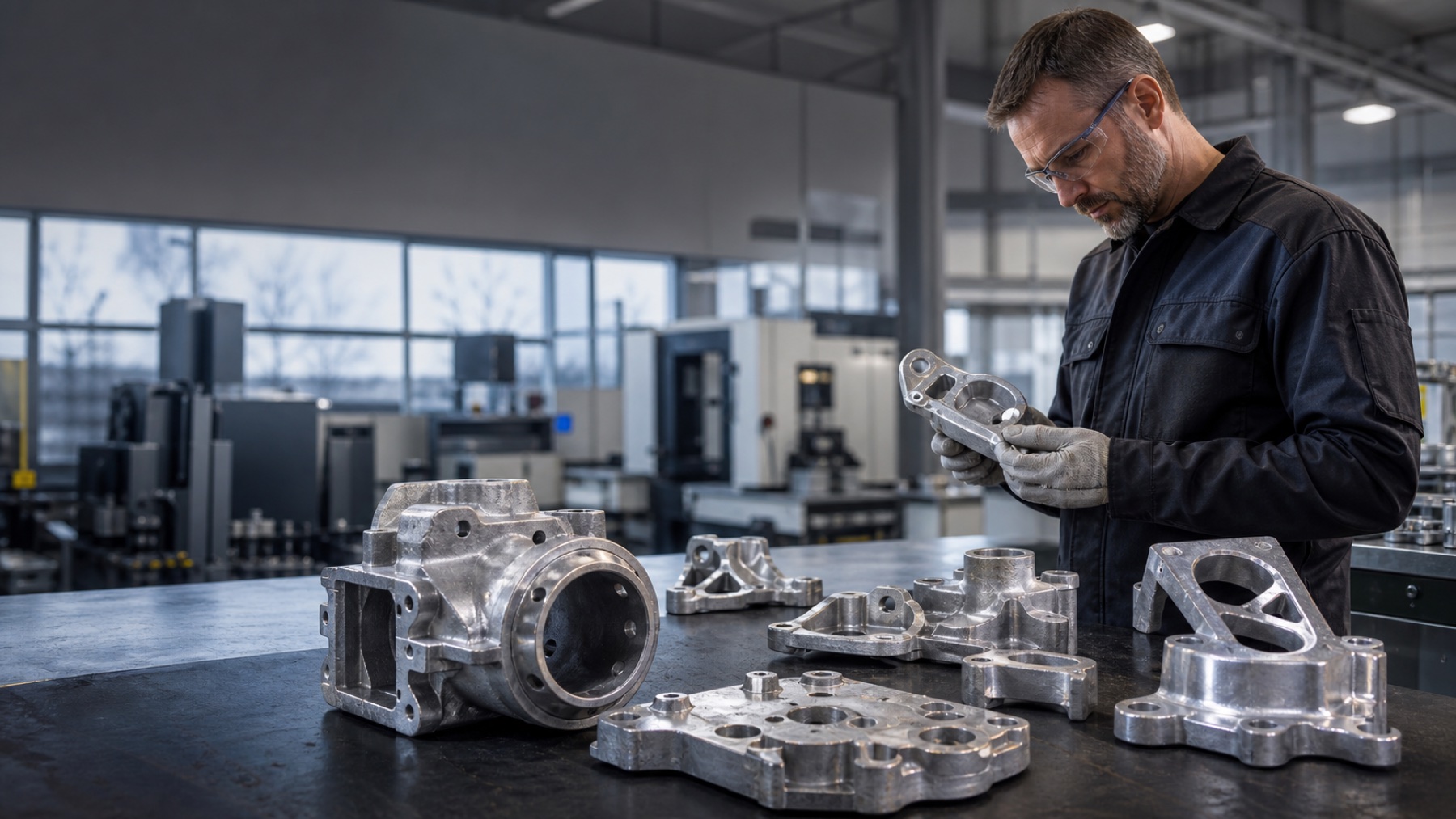
If you need cast parts in aluminium or zinc, the supplier does not have to be abroad. There are Norwegian manufacturers of cast components, including zinc die casting, which very few Norwegian suppliers offer. Here in Råde we cast and machine parts to the customer’s drawing and supply them in series.
The question is not whether Norwegian production always wins. It does not. The question is how to find a supplier that suits your part, and how to compare a Norwegian quotation with an import quotation fairly.
Checklist for choosing a manufacturer
These questions quickly show whether a supplier fits:
- The process. Does the supplier have the right casting method for the part: aluminium die casting, zinc die casting or gravity die casting? Not sure which? See aluminium casting.
- The material. Aluminium, zinc or both? How is the alloy chosen?
- The quantity. Which series suit the supplier’s model? For die casting it is typically a few thousand parts per year or per order, for gravity die casting typically a fifth to a tenth of that.
- The tool. Who owns it, who maintains it, and can it be moved?
- The post-processing. What is done in house, and what is outsourced? Machining, threading, heat treatment and surface finishing should be clearly stated in the quotation.
- The drawing review. Do you get input on the design before the tool is ordered?
- The documentation. What can the supplier document in terms of inspection, traceability and material for your particular part?
- The contact. Who answers when something deviates, and how many layers sit between you and production?
Norway or abroad: compare the same finished part
A quotation with a low unit price can look less attractive once the whole delivery is included. For a fair comparison, both quotations have to cover exactly the same finished part:
| Compare | Questions to ask |
|---|---|
| The part | Is it machined, threaded and surface finished in both quotations? |
| Quantities | The same quantity per order, the same annual volume and the same minimum order? |
| Tooling | Price, ownership, tool life, and who maintains it? |
| Sample parts | Are sample casting, measurement and approval included? |
| Freight and terms | Delivery terms, freight, customs, and who carries the risk in transit? |
| Stock | How much do you have to buy and store at a time, and how much capital does that tie up? |
| Quality and deviations | How are complaints handled, and how quickly? |
| Changes | What does it cost, and how long does it take, to change the design or the tool? |
| Follow-up | How much of your own time goes into following up the supplier? |
For large, standardised series with a stable forecast, an overseas supplier may be the right choice. A Norwegian supplier is not necessarily the cheapest or the fastest. But when the part will keep developing, has to be machined and finished, or when proximity to the tool and production matters, a Norwegian option belongs in the comparison.
If you buy aluminium goods from countries outside the EEA, it is also worth following the CBAM rules. The status as of September 2026 is in CBAM for buyers.
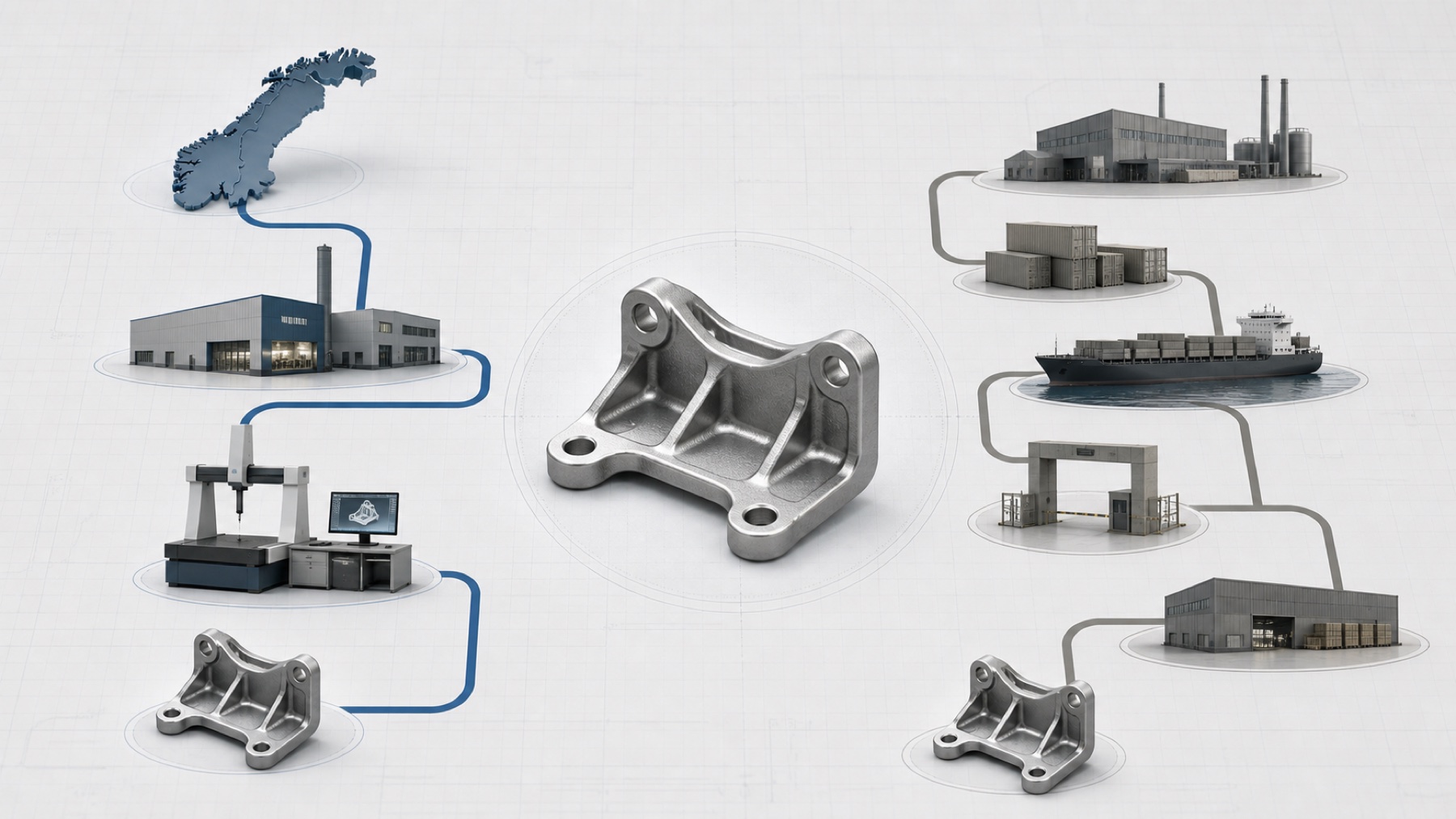
Editorial illustration generated for this article. It is not a photograph from the factory.
From drawing to finished part with us
- Drawing and requirements. You send a drawing or 3D model, quantities and functional requirements.
- Review. We look at wall thickness, draft angles, radii, parting line and machining allowance before the tool is ordered.
- Tooling. We procure the casting tool through our tool suppliers. You own it, and we maintain it.
- Casting. Die casting in aluminium or zinc, or gravity die casting in aluminium, depending on what the part needs.
- Finishing. CNC machining and blasting are done in house. Anodising and powder coating are done by sub-suppliers we coordinate.
- Series. The parts are supplied in series from the same tool.
Who does what along the chain is set out in from drawing to assembly-ready part. Whether casting pays off at your quantity is shown by the worked example in cast or machined from billet.
What to include in a first enquiry
- a 3D model and a technical drawing, if you have both
- quantity per order and expected annual volume
- the preferred material, or the functional requirements if the material is not decided
- critical dimensions, tolerances and functional surfaces
- requirements for surface, appearance and environment
- any need for sample parts, a measurement report or other documentation
- the timing you have in mind for samples and series start
Not everything has to be settled. An early conversation can reveal whether a feature should be cast, machined, moved or simplified before it becomes expensive to change.
Frequently asked questions
Is there a Norwegian supplier of zinc die casting?
Yes. We die cast both zinc and aluminium in Råde. Whether zinc suits your part depends on its geometry, functional requirements and quantity. Read more in zinc die casting: when zinc is right.
Can a Norwegian supplier deliver assembly-ready parts?
Yes, when the project suits it. We combine casting with CNC machining and blasting, and coordinate other surface finishing with a sub-supplier. The scope of delivery is agreed per part.
Is Norwegian production always more expensive?
No, but it is not always cheaper either. A proper comparison includes the whole delivery, not just the unit price.
Do you have a part that needs to be made in series?
Send us the drawing, the annual volume and the main functional requirements. We will assess whether aluminium or zinc casting suits it, which process is right, and what has to be clarified before a tool is ordered. More about the work we take on is under contract manufacturing.
- zinc
- die casting
- aluminium
- contract manufacturing
- lead time
- process chain
- import
- purchasing
- DFM