Regulation
CBAM 2027 for buyers of imported castings
Norway plans to introduce the carbon border mechanism from 1 January 2027. The biggest task is not the certificate price but the reporting you need in place. Status as of September 2026, without exaggeration.
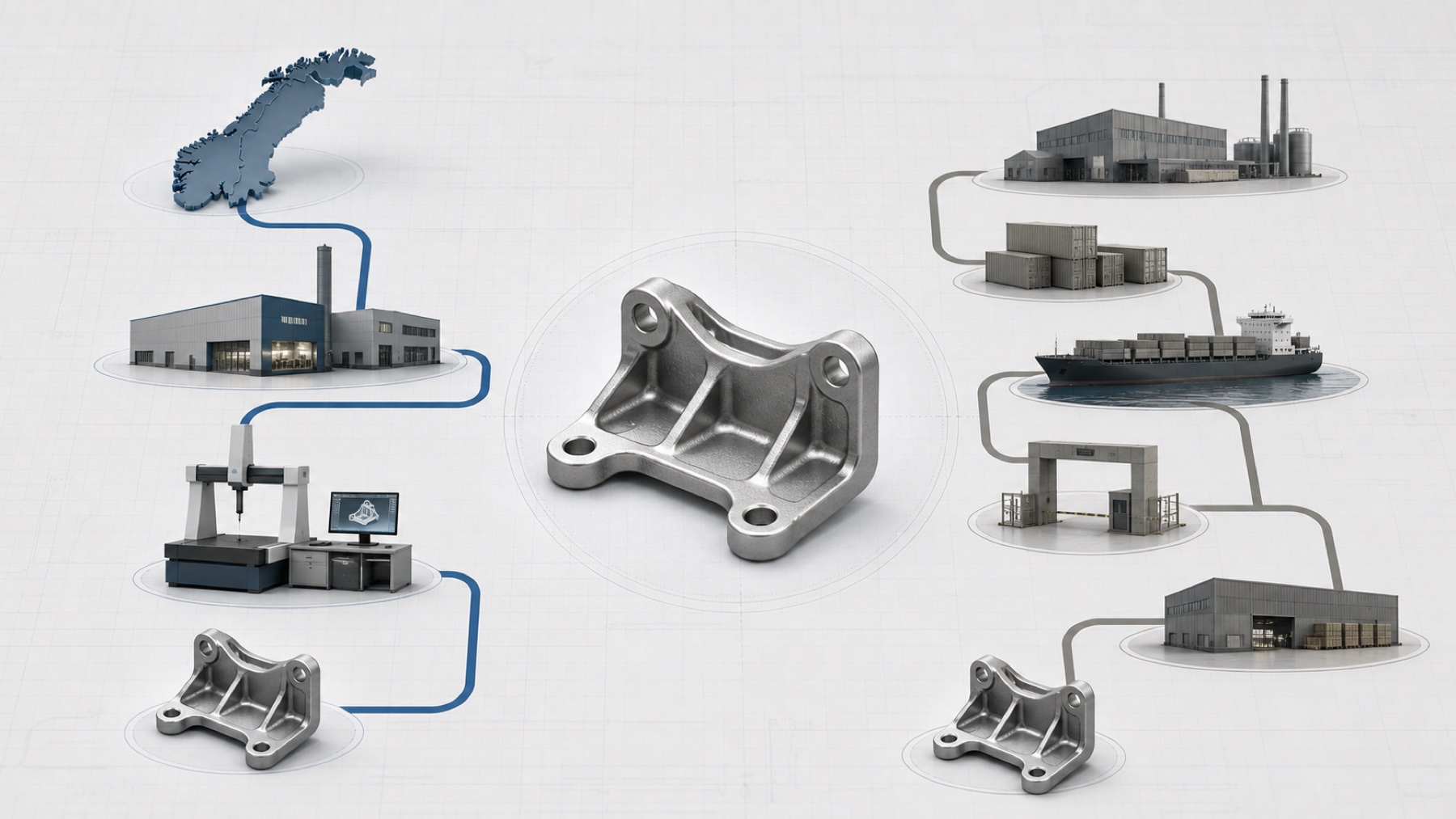
Regulatory status as of September 2026. The rules are still changing, so always check the current requirements with the authorities before making decisions. Links to the primary sources are at the end.
If you buy cast metal components from a supplier outside the EEA, it is worth knowing what happens from 1 January 2027.
This article tries to be precise rather than dramatic, for a simple reason: you probably deal with the regulations yourself and will spot exaggeration straight away.
What CBAM is
CBAM stands for Carbon Border Adjustment Mechanism, the EU mechanism for levelling the carbon cost between goods produced inside and outside the EU.
The principle is simple. Producers in the EU pay for their emissions through the emissions trading system. An importer buying the same goods from a country without carbon pricing avoids that cost. CBAM closes the gap by requiring the importer to buy certificates matching the emissions embedded in the goods.
Status in the EU
The definitive period has applied since 1 January 2026. Until then the scheme was a pure reporting obligation. For imports from 2026 there is a financial obligation: importers above the threshold have to buy and surrender CBAM certificates.
The scheme covers six groups of goods: cement, iron and steel, aluminium, fertilisers, electricity and hydrogen. Aluminium is included.
There is a threshold of 50 tonnes per year. According to the Commission, around 90 per cent of importers fall below it, while nearly all emissions are still captured, because the large importers sit well above it.
The certificate price is calculated in 2026 as a quarterly average. According to the Commission, the first quarter was set at 75.36 euro per tonne of CO₂ equivalent and the second at 75.28 euro. The third-quarter price is expected in October 2026.
Status in Norway
Norway plans to introduce CBAM from 1 January 2027. The Storting (Norwegian parliament) adopted the CBAM Act on 8 June 2026. As of September 2026, the regulation still has to be incorporated into the EEA Agreement. The Norwegian Environment Agency is the coordinating authority, Norwegian Customs is responsible for registration and import controls, and the Norwegian Tax Administration handles the authorisation of CBAM declarants.
The framework follows the EU: the same groups of goods and the same 50-tonne threshold.
According to Norwegian Customs, every business that will import CBAM goods into Norway has to register, regardless of quantity. Registration is planned to open in the autumn of 2026. Importers bringing in more than 50 tonnes of CBAM goods in a calendar year also need authorisation as a CBAM declarant. Above the threshold comes the obligation to document embedded emissions or use default values, to buy and surrender certificates, and to report.
The scheme applies to goods from countries outside the EEA. Goods originating inside the EEA are not covered, and the EU rules also exempt Switzerland.
Clarification: castings are outside the current scope
This is the most important point in the article, and it is where you should be sceptical of suppliers selling CBAM anxiety.
Finished aluminium castings are not covered by CBAM as the rules stand in September 2026. For aluminium, the scope covers selected goods in chapter 76 of the tariff, including unwrought aluminium and semi-finished products.
If you see a claim that castings are subject to CBAM today, it is not correct.
What has been proposed but not adopted
On 17 December 2025 the Commission published a proposal to extend the scheme to around 180 downstream products with a high steel and aluminium content, on average around 79 per cent. According to the Norwegian government’s EEA note, they include selected construction products, certain machine and engine components and finished goods where the metal content dominates. The proposed date of application is 1 January 2028.
Note two things. The proposal has to pass the ordinary legislative procedure in Parliament and Council. And the product list is still being negotiated, so which products end up on it is not settled.
So write “proposed”, not “coming”. That applies to us as well.
Why it still matters to you
Because the biggest task is not the certificate price.
A buyer who has to handle CBAM has to register, possibly apply for authorisation, set up a routine for collecting emissions data from suppliers, judge whether that data holds up or default values must be used, buy and surrender certificates on time, and document everything in case of an audit.
That takes time, and somebody has to own the task. Add that the product list is moving, and that an extension from 2028 could pull in goods you currently regard as outside scope. The question then is not only what a certificate costs, but how much administration you want in your supply chain.
What separates import from a supplier in Norway
For goods that are covered by CBAM, or could be after an extension, the difference between a supplier outside the EEA and a supplier in Norway looks like this:
| Import from outside the EEA | Supplier in Norway | |
|---|---|---|
| Registration as an importer of CBAM goods | Yes | No |
| Authorisation as a CBAM declarant | Yes, above 50 tonnes a year | No |
| Emissions data from the supplier | Yes, above the threshold | No |
| Buying and surrendering certificates | Yes, above the threshold | No |
| Affected by a possible extension | Possibly | No |
| Customs clearance on import | Yes | No |
The table says something about the administration around the purchase, not about the price per part.
What you should do now
1. Establish whether you are above the threshold. 50 tonnes of covered goods per year, in total. Below it, the financial obligation does not apply, but it is worth knowing how close you are.
2. Ask your suppliers whether they can provide emissions data. Not whether they will, but whether they actually can. If they cannot, you have to use default values, which are consistently unfavourable.
3. Check which components could be affected by an extension. Goods with a high metal content are candidates for the downstream list.
4. Review your supplier base in good time. Any change of supplier needs tooling, sample casting and approval, and that takes time whoever you switch to. How to compare the quotations: cast components in Norway.
Three terms to have straight
CBAM is the scheme itself: a charge on the carbon content of imported goods, introduced to stop European industry being undercut by production with higher emissions outside the EU.
EEA origin is what makes the scheme irrelevant for a component. If the part is made inside the EEA, it triggers no CBAM obligation under the current rules.
LME, the London Metal Exchange, is where the aluminium price is set. It explains why a quotation for castings can have a shorter validity than you expect: the part price is built on metal weight, and the metal is priced against the exchange.
What we do not claim
We do not claim that CBAM makes Norwegian production cheaper per part. It does not necessarily, and a foreign foundry with a lower hourly rate will still be cheaper on many parts in large quantities.
Nor do we claim that castings are subject to the charge today. They are not.
What we can say is that a component cast in Råde is an EEA good. Under the rules as of September 2026, and under the proposed extension, it triggers no CBAM obligation for you as the buyer. That is about predictability in purchasing, not about the environment or price.
Sources and current rules: Norwegian Environment Agency on CBAM (in Norwegian), Norwegian Customs on CBAM (in Norwegian), European Commission on CBAM and the Norwegian government’s EEA note on the proposed extension (in Norwegian). Certificate prices as published by the Commission on 7 April and 6 July 2026. This article is not legal advice.
- CBAM
- carbon tariff
- import
- EEA
- purchasing