Economics
Casting or CNC from billet? A worked example
A clearly labelled worked example shows how tooling cost, part price and quantity decide whether casting pays off, which three things often get forgotten, and when to keep machining.
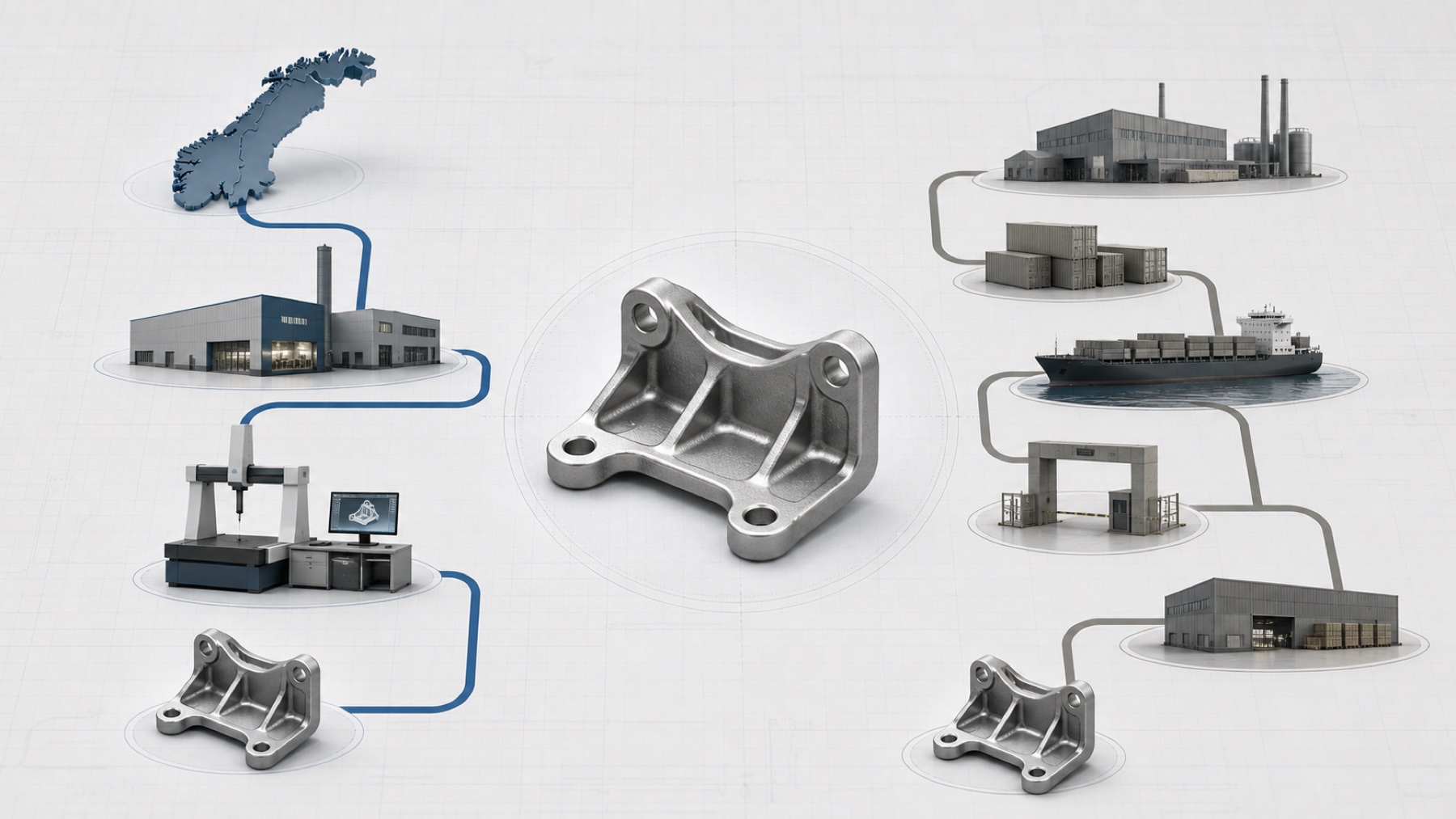
This is the switch we are asked about most often, and the most common source of a wrong decision, in both directions.
The starting point is two cost structures that look entirely different:
Machining from billet: no tooling cost, but a high cost per part that barely falls with quantity. You pay in machine time, and the machine time is the same for part number 5,000 as for part number 1.
Casting: a tooling cost before the first part, then a low cost per part. A die cast part leaves the tool in seconds.
The two lines cross somewhere. The whole discussion is about where, and the answer is different for every part.
The arithmetic
Call the tooling cost T, the cost per machined part C₁ and the price per cast part C₂. Include any machining still needed after casting in C₂.
N = T ÷ (C₁ − C₂)
N is the number of parts before the tool has paid for itself. Below N, machining is cheaper. Above N, casting is cheaper, and the gap widens with every part.
A worked example with made-up figures
The figures below are chosen to keep the arithmetic simple. They are not our prices and say nothing about what your part costs.
Assume a tool at NOK 100,000, a machined part at NOK 150 and a cast part at NOK 50. Then N = 100,000 ÷ (150 − 50) = 1,000 parts. Change one assumption and the point moves a long way:
| Assumption | T (NOK) | C₁ (NOK) | C₂ (NOK) | N (parts) |
|---|---|---|---|---|
| Starting point | 100,000 | 150 | 50 | 1,000 |
| Saving per part halved | 100,000 | 150 | 100 | 2,000 |
| Tool costs twice as much | 200,000 | 150 | 50 | 2,000 |
| More material waste when machining | 100,000 | 175 | 50 | 800 |
| The casting needs some machining | 100,000 | 150 | 75 | 1,333 |
The lesson is not that 1,000 parts is the limit. There is no limit that applies to every part. The point is that N is very sensitive to the saving per part, and that the three factors below often decide whether the answer comes out right.
Three things that often get forgotten
1. Material waste. A machined part starts as a block, and everything that is not part becomes swarf. On a bracket with pockets, ribs and through holes, the swarf can be a large share of the starting material. A casting starts close to its final shape, and runners and overflows are remelted. When the metal price rises, the waste costs more, and casting pays off earlier.
2. The whole life of the series. Many people reject casting because they calculate on the first order. If the product will live for ten years, ten years of volume belongs in the calculation. A part you make 3,000 of a year is a part you make 30,000 of over ten years, and the difference between those two figures is often the difference between no and yes. Include spare parts too: if the part has to be available long after the main series ends, the tool has to stay in place anyway.
3. The geometry can get better. When you cast, you are not drawing the same part. A machined bracket is limited by what the cutter can reach. Pockets get the cutter’s radius, internal cavities are difficult, and ribs cost machine time. A cast bracket can have a thin shell with ribs where the bending moment is, cored holes and metal concentrated where the stress is high. The part often ends up both lighter and stronger. That is not a saving but a better part, and it belongs in the assessment.
When machining is right at any quantity
- The part will not be made again. The tooling cost is then wasted, however many parts that single run has.
- The geometry is too simple. A round disc with a hole in the middle has little to gain from casting. Turning is both faster and cheaper.
- Almost every dimension is critical. If almost everything has to be machined anyway, you have paid for a tool without avoiding the machining.
- The material is one we do not cast. Stainless steel, titanium and copper alloys. We cast aluminium and zinc.
- The design is not finished. If the geometry will change several more times, a tool is premature. Machine the prototypes, lock the design, then cast.
Even when N is low, the series has to suit the production. Die casting typically means a few thousand parts per year or per order, gravity die casting typically a fifth to a tenth of that. The same principles apply to zinc die casting.
The middle route: cast the blank, machine what must be machined
It is rarely either or. For a part with a few critical dimensions, it often pays best to cast the blank and machine only the faces that need it. The part is cast with machining allowance on the critical faces and finished geometry everywhere else. Then only what has to be tighter than casting delivers is milled or turned, in our own CNC machining.
One of our product examples is a zinc die cast bracket threaded and made assembly-ready here.
The other methods
Casting and machining are not the only options. Injection moulding in plastic is strong when the part does not have to conduct heat or carry a load for years. MIM wins on small, complicated parts in high quantities. Metal 3D printing has no tooling cost and suits prototypes and the very smallest runs, but the cost per part barely falls with quantity. Laser cutting and press braking make the part from sheet, and stamping beats most things on price when the part is thin, flat and made in very high quantities. The rule of thumb: the more geometry the part has in three directions, the earlier casting pays off.
What to send us
- The drawing or 3D model, preferably as STEP.
- What you pay per part today, if the part is already being made.
- Annual volume and expected product life.
- Which dimensions are actually critical, only those that determine the function.
We then work out N with you, using real figures for your part, and tell you if the answer is that you should carry on machining. What the tool itself costs is explained in what does a casting tool cost. Request a quote.
- volume
- break-even
- CNC
- substitution
- material waste