Economics
What does a casting tool cost? Tooling, samples, part price
The tool, the sample parts and the part price are three different bills. Here is what drives tooling cost, the arithmetic for when the tool has paid for itself, and what we need to quote.
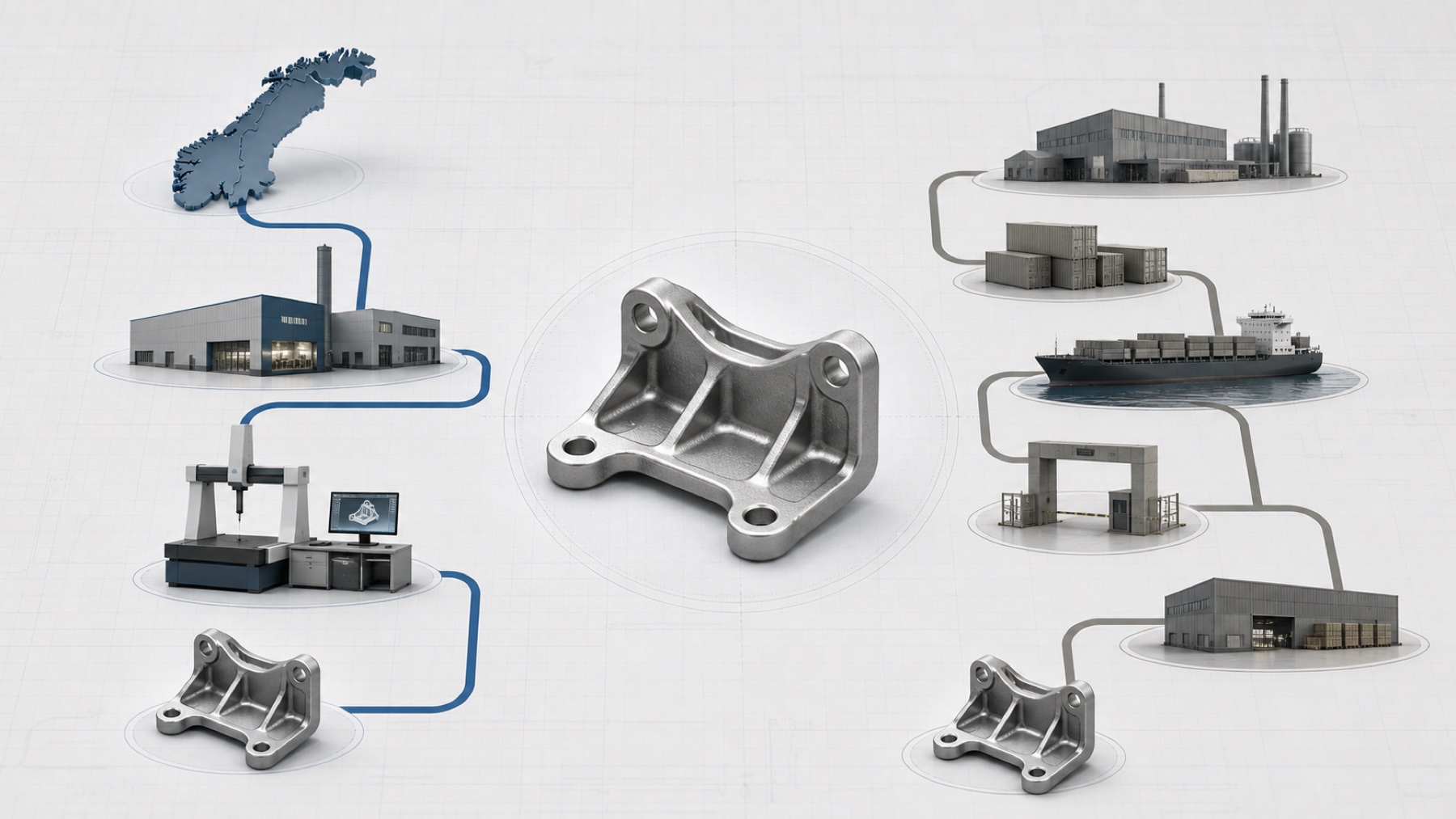
The first thing a buyer asks is what the tool costs. The second is why nobody answers.
The reason for the second is simple and slightly dull: a figure without the geometry is wrong. Two parts that weigh the same and look broadly alike can have very different tool prices because one of them has a hole in the side. So there is no price list here. What you get is the cost structure, the arithmetic that decides whether the tool pays off, and a list of what we need in order to give you a concrete quotation.
Three bills that often get mixed up
A quotation for cast parts contains three different costs, and each should be assessed on its own:
- The tool. A one-off investment. With us the customer pays for the tool and owns it. We procure it through our preferred tool suppliers, designed for our machines, and maintain it throughout the series. More under tooling.
- The sample parts. Before the series starts, the first parts are cast and measured, and the tool is adjusted if needed. Ask what is included and what is invoiced on top.
- The running part price. It is calculated from the metal weight, including runners and overflows, and the cycle time in the machine, with additions for post-operations such as fettling, machining and surface finishing. The quantity per order also affects the price, because every machine changeover is a fixed cost.
If you are comparing quotations, compare each of the three separately.
What drives the tooling cost
Part size and projected area. Projected area is the area the part covers seen along the tool’s closing direction, including runners and overflows. It determines the machine size and clamping force required, and therefore how large the tool has to be.
Number of cavities. A multi-cavity tool casts several parts per shot. That lowers the price per part but raises the tool price, though not in proportion, because the frame, cooling and ejection system are shared. The cavity count should be worked out from the annual volume, not chosen from habit.
Slide cores. The item that most often surprises. A slide core is a moving part of the tool that withdraws sideways before the part is ejected. It is needed whenever the geometry has something that does not release straight out, such as a hole in the side, a groove or a hook. Every slide core means more mechanics, more machining and more that can wear, and it lengthens the cycle. If the geometry can change so the slide disappears, that is often the largest single saving in the project. It is one of the first things we look for in the design review.
Steel grade and surface. The tool is made from hot work steel, and the steel quality affects both price and life. If the part needs a polished or textured surface straight from the tool, the work on the tool surface comes on top.
Cooling. The cooling channels govern how fast and how evenly the part solidifies. Good cooling gives a shorter cycle and stable dimensions through the series, and it rarely pays to save here.
Lead time. If the tool has to be made faster than normal, it costs more. Someone else’s job has to be moved.
The arithmetic that decides whether the tool pays off
Call the tooling cost T, today’s cost per part with your present method C₁, and the price per cast part C₂. The number of parts before the tool has paid for itself is then:
N = T ÷ (C₁ − C₂)
Three things are worth noting. The calculation is very sensitive to the saving per part: halve it and N doubles. It should cover the whole life of the product, not just the first order. And the tool does not last forever. If you will make more parts than the tool survives, you will have to buy another. This is where the metal matters: the German zinc die caster Adolf Föhl states 750,000 to 2,000,000 shots for zinc tooling, eight to ten times the life of an equivalent aluminium tool. A worked example with made-up figures is in cast or machined from billet.
Why quotations vary so much
Ask five suppliers and you get five figures. That is rarely overcharging. More often they have answered five different questions:
- How many cavities did they assume?
- What tool life is the tool designed for? A tool built for 50,000 shots and one built for 500,000 are not the same product.
- Are sample casting and adjustment included?
- Is maintenance included in the part price, or invoiced separately?
- Who owns the tool and the tool drawings?
Ask for the tooling quotation to answer all of this, and to state the number of slide cores and the lead time from order to first approved sample part. Without those answers you are comparing numbers, not quotations.
Who owns the tool
With us the customer pays for the tool and owns it. That means the tool is your asset, not ours, and the part price is not hiding a tooling write-off you cannot see. The lock-in is practical rather than legal. Ask for ownership to be put in writing, whichever supplier you buy from.
What we need to quote
- The drawing and 3D model, preferably STEP as well as PDF.
- Quantity per order and estimated annual volume, and how long the product will live.
- The material, if it has been decided. If you are unsure, say so.
- Critical dimensions and functional requirements: what the part has to withstand, and which faces are to be machined.
- Surface requirements, such as coating, anodising or visible faces.
- Whether a tool already exists. Whether an existing tool can be used here has to be assessed case by case.
You then get a tooling quotation and a part price after a technical review. If the quantity is too small for the tool to pay off, we will say so. Die casting typically pays from a few thousand parts per year or per order, gravity die casting typically from a fifth to a tenth of that. Below that, machining, sheet fabrication or 3D printing is often the better route, and we will recommend it. Request a quote.
- tooling
- price
- volume
- break-even
- contract manufacturing