Material selection
Zinc vs aluminium die casting — a decision guide
Zinc vs aluminium die casting comes down to six questions, and weight is only the first. Here is the decision table, the three most common wrong turns, and why the heavier metal is sometimes the right one.
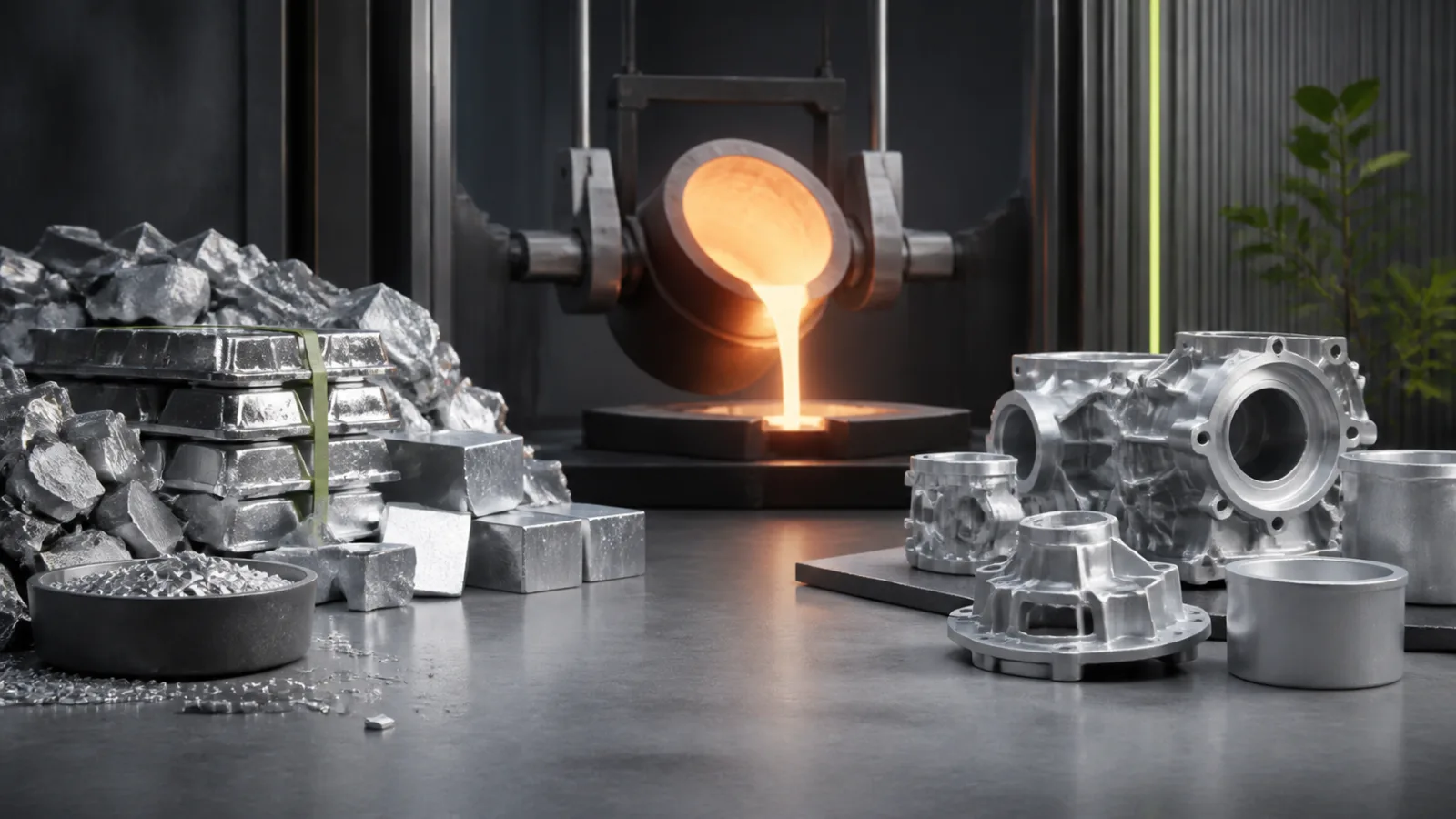
Most material choices we see in enquiries were made before anyone thought about them. Aluminium is the default answer because aluminium is familiar, and because “lighter is better” is a rule of thumb that holds roughly half the time.
Here is a more useful approach: ask six questions, in this order.
The hard numbers first
| Zinc | Aluminium (AlSi) | |
|---|---|---|
| Density | Substantially higher | 2.7 g/cm³ — about 1/3 of steel |
| Temperature | Melts at approx. 380–390 °C | Cast at 680–700 °C |
| Machine type | Hot chamber | Cold chamber |
| Cycle time | Shorter | Longer |
| Tool life | 8–10× aluminium (source: Adolf Föhl) | The reference |
| Minimum wall thickness | Down to 0.3 mm (source: Adolf Föhl) | Thicker |
| Detail reproduction | Sharpest | Good |
| Dimensional stability | Best | Good |
| As-cast surface | Best | Good |
| Heat treatment | No | Yes, in gravity casting |
| Anodising | No | Yes, with caveats |
| Threads directly in the metal | Very well suited | Well suited |
The table explains most of it. But it decides nothing until you know what the part has to do.
Question 1: Will the part be lifted or carried?
If yes, aluminium is probably right and you can almost stop here.
Aluminium weighs about a third of steel, and the difference against zinc is large enough to feel in the hand. On a bracket in a mobility aid the user has to lift into a car, on a part in handheld equipment, or on something sitting high in a vessel where it affects stability — there the weight is a functional requirement, not a preference. One example is the bracket for the mobility aid industry, die cast in aluminium.
Question 2: Does the weight do a job?
This is the question people forget to ask.
Mass damps vibration. In a loudspeaker cabinet a light housing radiates more unwanted sound than a heavy one. In a machine part that has to absorb vibration from a motor, the same applies. In a furniture fitting, weight in the hand is read as quality by the end user, and that is a real product property even when it is not in the specification.
If the answer is yes, the assessment inverts. Zinc is then not a compromise — it is the specification. See the zinc loudspeaker housing and the zinc furniture bracket.
Question 3: Does the part need heat treatment?
If yes, the material choice is settled: aluminium, gravity die cast. See the heat treated gravity die cast bracket.
The hardening mechanism — solution treatment, quench and controlled ageing — belongs to heat-treatable aluminium alloys. Zinc cannot do this.
Note that choosing aluminium here drags a process choice with it. Aluminium die castings normally cannot be heat treated, because trapped gas causes blisters when heated. If you need T6 strength, the part has to be gravity cast, and that affects tooling cost, cycle time and minimum volume.
Question 4: How much detail, and how thin?
If the part is small, full of geometry and has thin sections, that points to zinc.
Zinc fills thin areas precisely, reproduces sharp edges and fine textures better, and gives a surface that is often finished straight from the tool. On a small housing with screw bosses, ribs and a sealing face, that is the difference between a part that needs finishing and one that does not.
Question 5: How many will you make, and over what period?
This is where tool life enters, and it is almost always overlooked.
The tool is worn by thermal shock on every shot. Aluminium, cast at around 700 °C, wears the steel far faster than zinc, which melts at around 380 °C. Adolf Föhl states 750,000 to 2,000,000 shots for zinc tooling, eight to ten times an equivalent aluminium tool.
Because the customer owns the tool in our model, this is your cost. If the series runs for many years in large numbers, the question of one tool versus three can exceed the difference in unit price. Calculate across the whole life, not just the first order.
Question 6: Where does the part sit, and what must it withstand?
Service temperature. Zinc has a lower service temperature than aluminium. If the part sits near a heat source, this has to be checked against the alloy first.
Corrosion environment. Both materials have to be assessed against the environment. In a salt atmosphere the copper content of an aluminium alloy is the single factor that matters most for corrosion resistance — and that is a detail settled in the alloy choice, not in the coating.
Surface requirements. If the part is to be anodised, the answer is aluminium. But be aware: casting alloys with high silicon content anodise darker and less evenly than extruded profiles, because the silicon particles do not oxidise. If a casting is to be anodised and look good, both the alloy and the expectation must be settled early.
The three most common wrong turns
“Aluminium because it is lighter.” Right when weight is a requirement. Wrong when the weight makes no difference and you simultaneously give up detail reproduction, dimensional stability and tool life.
“We pick the metal with the lowest price per kilo.” Zinc is heavier than aluminium, so price per part does not follow price per kilo. Calculate on part weight, not material price.
“We have always used aluminium.” The most common, and the most expensive. The material choice should be revisited when the geometry changes, when the volume changes, or when the tool is due to be rebuilt anyway.
The designations that belong on the drawing
"Aluminium" and "zinc" are metals, not specifications. It is the alloy designation that decides what the part will take, and it belongs on the drawing.
On the aluminium side the common casting alloys are the AlSi — aluminium-silicon family. Silicon is what makes the melt fluid enough to fill a thin wall, and the copper and magnesium content decides the rest: strength, response to heat treatment and corrosion resistance.
On the zinc side the alloys are Zamak — zinc alloys, named after zinc, aluminium, magnesium and copper. They differ mainly in copper content, and the choice between them is about hardness and dimensional stability over time.
The feedstock arrives as ingot and is remelted at the foundry. Where the aluminium is secondary aluminium — remelted scrap realloyed to standard — the energy used is a fraction of primary metal, with no change to the material data.
If the part is to be heat treated, the result is given as a temper rather than as a process: T5 temper after controlled cooling straight from casting temperature, and T6 temper after solution treatment and artificial ageing. T6 gives substantially higher strength, and it belongs to gravity cast aluminium — pressure die cast parts are not normally heat treated.
The practical advice
Always ask for the alloy designation on the quotation, not a material description. “Aluminium” is a material family. “EN AC-46000” is a specification you can compare two suppliers on.
And say in the enquiry what the part has to do, not just what it has to weigh. Send the drawing or the sketch and you get a reasoned answer on material after a technical review. The services are described under zinc die casting and aluminium casting. Request a quote.
- zinc
- zamak
- material selection
- aluminium
- AlSi