Electronics and audio
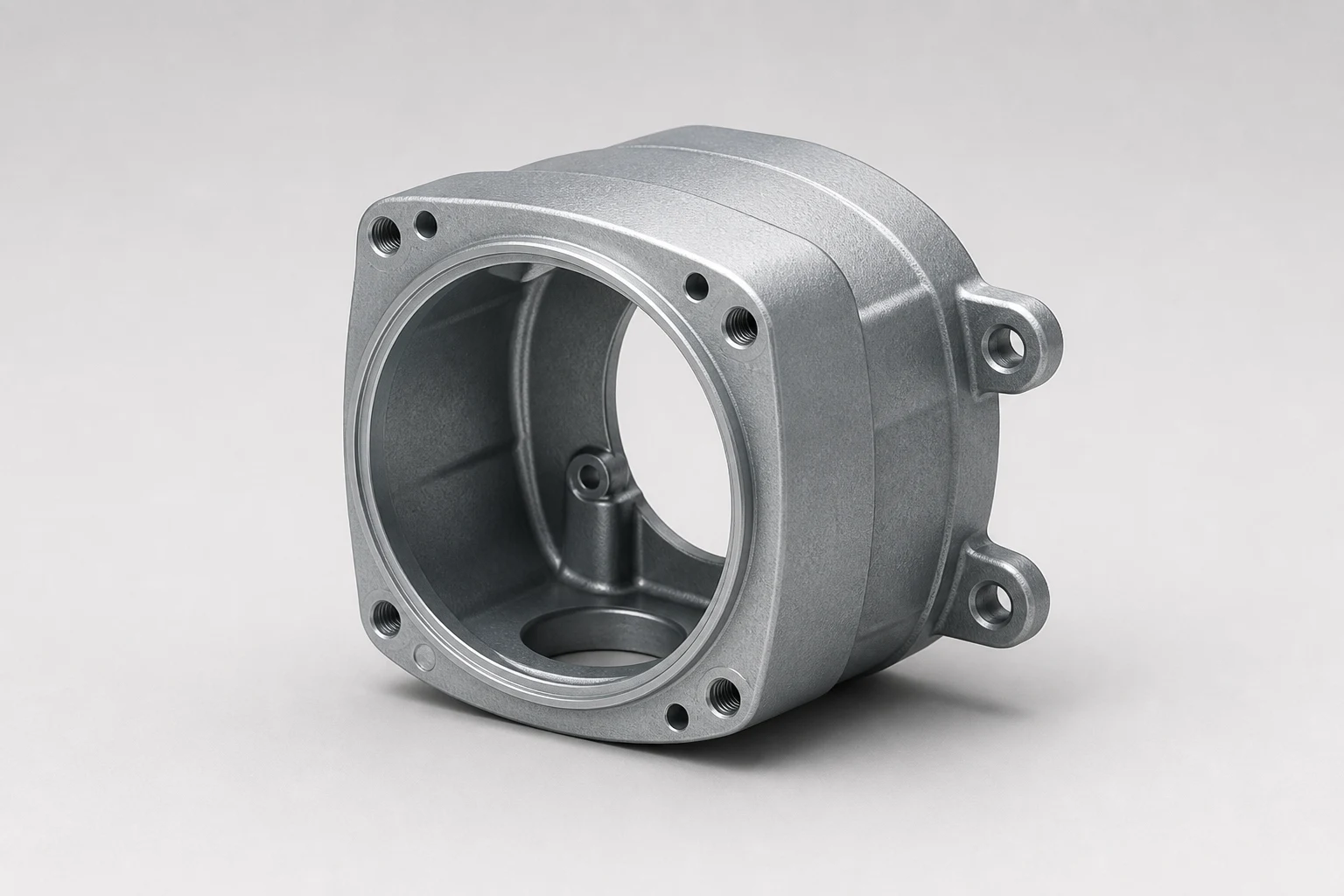
Zinc loudspeaker housing
An enclosing part for audio equipment, die cast in zinc. Here weight is not a compromise — it is the function. A heavy housing damps unwanted vibration, and zinc is the heavier metal.
The challenge
Many people who bring us a part have a weight requirement that points downwards. Lighter is better, aluminium is lighter than steel, and the conversation is over.
In audio equipment that is inverted.
A loudspeaker enclosure has an acoustic problem: the driver moves, and the reaction force from that movement sets the housing vibrating. A housing that vibrates radiates its own sound — and that sound does not belong in the signal. It colours the tonal balance, makes the bass indistinct and lays a veil over the detail.
The remedy is mass and stiffness. The heavier and stiffer the cabinet, the less it moves under the same force. It is simple physics: the same force produces less acceleration in a greater mass.
The challenge was therefore not to make the part light. It was to get as much mass and stiffness as possible into a given geometry, with a surface that can be looked at, and with dimensions that hold when two halves have to meet along a joint.
The solution
Zinc die casting. The material choice is the technical decision in this case, and it is worth spending space on why.
Zinc is heavier than aluminium — and that is the point. In almost every other context that is a drawback. Here it is the specification. Choosing aluminium because it is “better” would have given a lighter housing that vibrates more. The right metal for the job is not the lightest metal.
Zinc also gives everything else the housing needs:
- Thin, even walls. Zinc flows well in the die at low temperature and fills thin sections precisely. That means the mass can be placed where it is needed — in walls and stiffening ribs — rather than sitting as an even block everywhere.
- Dimensional accuracy. Two halves meeting along a joint must hold the same dimensions in every single part. Zinc holds dimensions better than aluminium.
- Surface straight from the tool. Of the processes we run, zinc die casting usually gives the finest surface straight from the tool. A lower casting temperature means less thermal load on the tool and sharper reproduction of detail.
- Tool life. Zinc melts at around 380–390 °C, while aluminium is cast at 680–700 °C. That difference feeds straight into how long the steel tool lasts. Since the customer owns the tool, it is the customer’s investment that lasts longer.
- Mountings cast in. Screw bosses, ribs and locating pins come with the shot, not with a post-operation.
Design moves that suit a housing like this: internal ribs give stiffness without building thickness into the shell; screw bosses are cored from behind and tied in with a rib rather than blending into the wall, so no shrinkage void forms where the section is thickest; the parting line is placed where the cabinet is not seen.
The result
A housing where the mass does acoustic work, the surface is finished straight from the tool, and the joint faces meet identically in every single part.
This case is why we talk about material advice at all. A supplier who only knows aluminium would have proposed aluminium — and the part would have been lighter, cheaper per gram and worse at its job.
It is also why we think zinc die casting is worth talking about as a service in its own right. Very few Norwegian suppliers offer it. If you need finer detail, thinner walls, better dimensional accuracy or mass, the choice of Norwegian suppliers is small.
The right metal for the job. Not the lightest metal.
Zinc because mass is the function, not a compromise — and because the material simultaneously delivers thin walls, high dimensional accuracy, a good as-cast surface and long tool life. High pressure die casting because a housing requires thin, even walls with mountings cast in during the same operation.