Bracket for the vehicle industry
A zinc die casting that feeds into a vehicle supply chain. The requirement here is not primarily strength, but that every part in the series matches the first one, and that the delivery arrives on the agreed day.
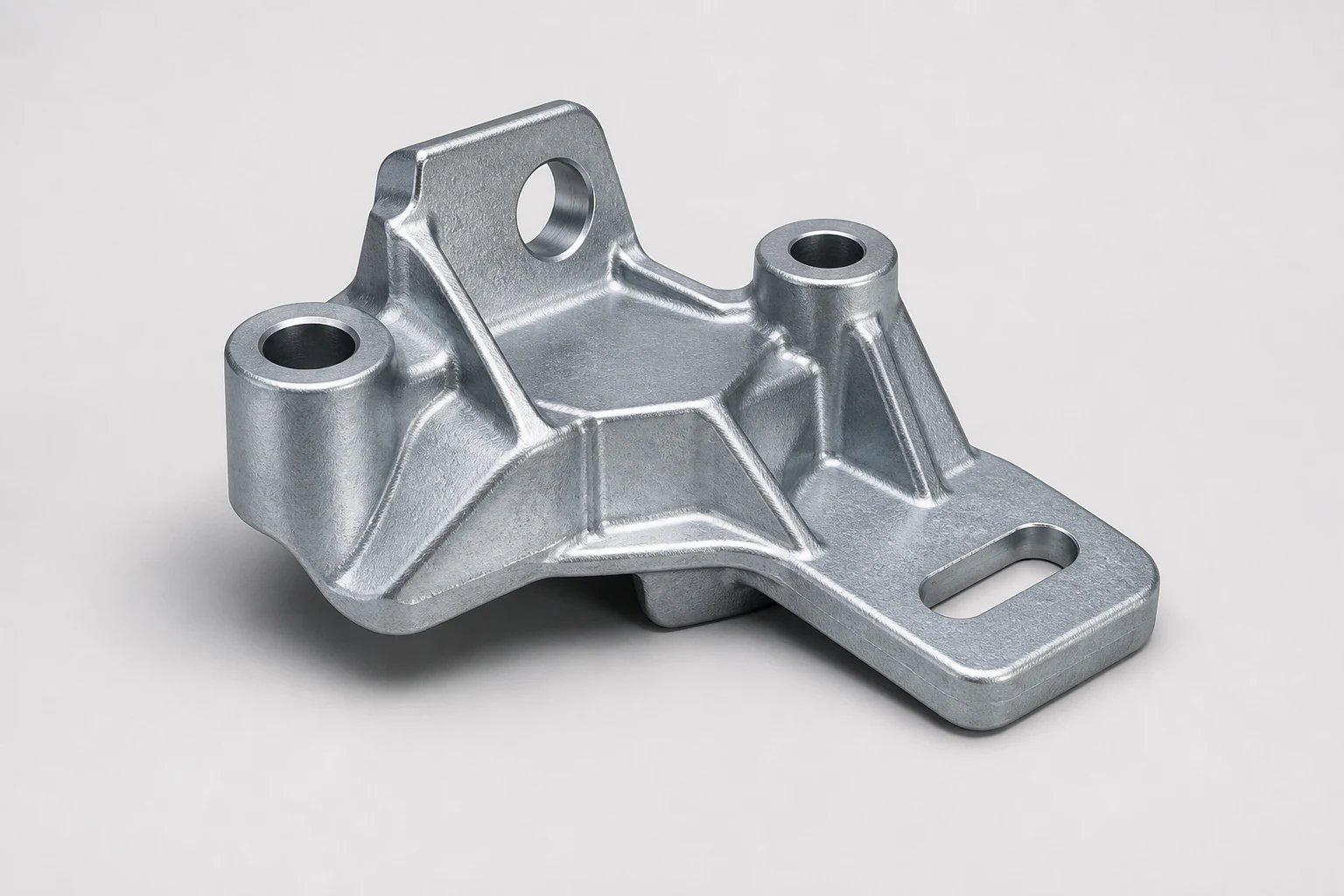
The challenge
The vehicle industry is the most demanding supply chain a component manufacturer can feed into, and strength is rarely the difficult part. Three other things are:
Repeatability. The part is fitted on a line that is not supposed to stop. If a hole sits out of position in a batch, the line can stop, and then the cost is not the part but the line.
Dimensional accuracy over time. A die wears. Flash increases and dimensions drift. A part that was inside tolerance early in the series must still be inside it many thousands of shots later. That takes maintenance discipline on the tool, not just inspection of the parts.
Delivery precision. Call-offs arrive at short notice and have to hit a date. A delay propagates up the chain.
The solution
Zinc die casting, with tool maintenance as a running part of the delivery.
Why zinc here. Zinc holds dimensions better than aluminium and is cast at a much lower temperature. That gives two things that matter in this chain: sharper reproduction of detail and substantially longer tool life. When the last part in the series has to match the first, the wear of the tool matters as much as the process parameters.
Tool maintenance throughout the series. The customer owns the tool, and we maintain it continuously. That is the precondition for repeatability holding across years.
A running relationship, not a one-off order. The customer-owned tooling model presupposes that the series runs for a long time. So both the customer and we have an interest in the tool being in good condition late in the series, not only at the start.
The result
A part delivered in series into a demanding supply chain, with the same geometry over time.
Here we should be precise about what the example shows. Supplying a vehicle manufacturer directly normally requires IATF 16949 certification. The example only says that the bracket goes into a vehicle supply chain, not which tier the customer is, and we claim nothing more than that.
The example is included because it shows that our parts go into supply chains where repeatability and delivery precision are measured, not merely agreed.
Zinc because dimensional accuracy across a long series is the critical requirement, and because the low casting temperature gives a tool life that carries the whole production run. High pressure die casting because the volume demands short cycles.
More case studies
Mobility aids
Bracket for the mobility aid industry
A load-bearing bracket, high pressure die cast in aluminium, for wheelchairs and walking aids. The part must be light enough for the user to lift the device, and strong enough to carry the user.
Zinc bracket threaded in house
A zinc die cast bracket, threaded and finished here so the customer can take it straight into assembly. The part does not leave the building between casting and threading.
Garden equipment
Bracket for garden equipment
An aluminium die casting for consumer volumes, cast with the bearing fit and pressure tightness straight from the tool — with no subsequent machining.