Aluminium
Garden equipment
Bracket for garden equipment
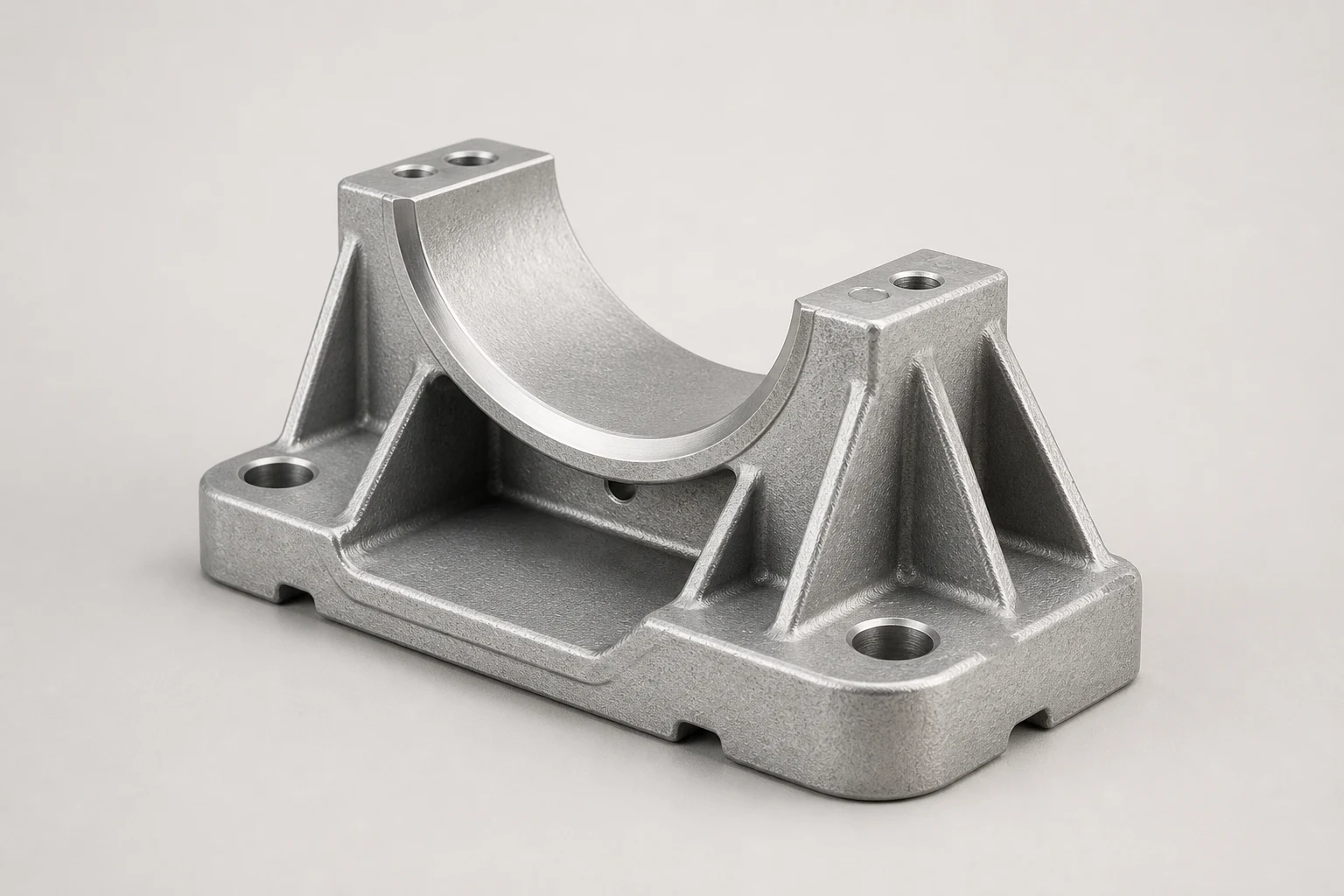
An aluminium die casting for consumer volumes, cast with the bearing fit and pressure tightness straight from the tool — with no subsequent machining.
Casting and machining in Råde. Surface finishing coordinated by us.
Garden equipment
Components for garden equipment, such as brackets and mounts, where cost per part decides. Every gram removed during design pays off across the whole series.
Common failure points
Why casting
At consumer volumes, cycle time is everything. A die cast bracket comes out of the tool in seconds, fully formed with holes, ribs and fixing points. The same part machined from billet costs minutes of machine time per piece — and across tens of thousands of parts that difference is the entire business case.
Brackets and mounts in handheld and walk-behind equipment: handle mounts, gear housings, blade mounts, engine mounts and wheel supports. Parts like these are usually die cast in aluminium where weight matters, and in zinc where the detail is fine and the quantity large. We have supplied a die cast aluminium bracket for garden equipment.
Price is the whole discussion. In this market the margin sits in the part, not in the brand. We price on metal weight and cycle time, and both can be influenced during design. A worked example: removing ten grams of unnecessary metal from a part you make 40,000 of a year saves 400 kilos of metal a year, and the cycle gets shorter because a thinner section solidifies faster.
Here you can put a number on positive product criticism yourself: a design change turns into money.
Tolerances that avoid post-processing. Every operation after casting costs money when quantities are large. If we can cast the bearing fit directly, a whole operation disappears from the calculation. On the bracket in the product example the bearing fit was held as cast, with no machining. That requires a realistic tolerance and a tool built for it, and it is settled before the tool is designed.
Environment across many seasons. The tool sits in a shed over winter, is used in rain and sun, and gets pressure washed. The surface treatment has to be judged against that, not against the shop shelf.
Vibration. Engine mounts see cyclic load for their entire service life. That makes radii and freedom from porosity in loaded sections more important than it sounds for a consumer product.
On very large quantities of a simple part, a foreign die caster will often have a lower hourly rate than we do. What we can offer is a short run, proximity to the tool and a part that can arrive fully machined, not the lowest unit price in the world.
Which annual volumes suit, and whether we can hold stock and deliver against call-offs through the season, are settled for your part. For this industry that question often matters more than the unit price.
Cast brackets made to drawing
An aluminium die casting for consumer volumes, cast with the bearing fit and pressure tightness straight from the tool — with no subsequent machining.
Garden equipment
Garden equipment
An aluminium die casting for consumer volumes, cast with the bearing fit and pressure tightness straight from the tool — with no subsequent machining.
State annual volume and order size in the enquiry. Those are the two figures that decide whether casting pays off for you.
We look at the part and the requirements before we work out a price, and tell you if casting is not the right method.
We count visits anonymously to make the website better. Google Analytics only loads if you say yes. Read more